
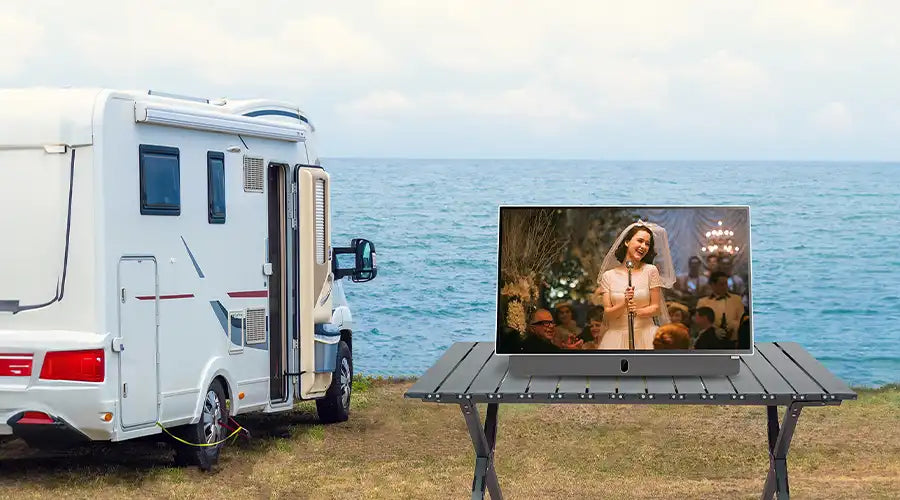
The concept of television has changed dramatically. It is no longer limited to a fixed screen attached to a wall or cabinet. In 2026, television has become mobile, flexible, and battery-powered. The growth of the portable smart TV has made entertainment more adaptable, whether the setting is an RV, a campsite, a kitchen, or a temporary backup situation during a power interruption.
This guide is designed as a detailed reference rather than a simple review. Whether you are interested in display specifications, battery behavior, connectivity, or real-world usage scenarios, the following sections bring everything together in one complete format.

1. The Evolution of Portable Entertainment
To understand the current generation of portable TVs, it helps to look at how the category developed. Early portable televisions were compact CRT products with small screens, limited image quality, and high battery consumption. They were innovative for their time but constrained by the technology available.
Today, advances in lithium battery density, LED backlighting efficiency, and compact system-on-chip processing have created a new class of devices. These products are no longer simply smaller televisions. In many cases, they operate as compact entertainment platforms with streaming capability, wireless connectivity, and external input support.
Modern portable TVs commonly serve three different roles:
- The media streamer: A smart display platform for Wi-Fi-based content services.
- The broadcast receiver: A portable screen capable of receiving free-to-air channels where tuner support is included.
- The external monitor: A secondary display for consoles, laptops, and other HDMI or USB-C devices.
2. Deep Dive: Technical Specifications
Specification sheets can appear complex at first, but several key parameters have the greatest impact on actual user experience.
Resolution: Why 1080p Is the Sweet Spot
Although 4K panels exist in some small-format displays, 1080p is often the most practical resolution for a 14 to 16-inch portable TV. At this screen size, the difference between Full HD and 4K is often difficult to notice in normal viewing conditions, while higher-resolution panels usually require more processing power and battery energy.
Brightness
Because portable TVs are frequently used in variable environments, brightness is especially important. For indoor and mixed-use scenarios, a range around 300 to 400 nits can offer a more usable viewing experience than lower-brightness screens, especially in kitchens, sunlit rooms, or shaded outdoor areas.

3. Understanding Panel Technology: IPS vs. VA vs. TN
Panel type has a major effect on viewing angle, color consistency, and contrast performance. This is one of the most important hardware choices in a portable TV.
| Panel Type | Advantages | Limitations | Best Fit |
|---|---|---|---|
| IPS | Wide viewing angles and more consistent color | Lower contrast compared with VA | General use, shared viewing, travel, and camping |
| VA | Higher contrast and deeper black levels | Narrower viewing angles | Solo movie watching in darker settings |
| TN | Fast response time and lower cost | Weaker color performance and poor viewing angles | Budget-focused use cases rather than TV-centered viewing |
Recommended choice: IPS panels are often the most balanced option for portable TV use because they maintain image quality better when viewed from different positions, which is especially helpful in kitchens, campsites, and shared spaces.
4. Battery Tech and Power Management
The practical value of a portable TV depends heavily on how well it manages power. Many higher-end portable models use lithium-polymer battery designs because they support slim construction and portable form factors.
Understanding mAh and Wh
Battery specifications are often presented in milliamp-hours, but watt-hours are usually the more useful metric when estimating runtime. A portable TV in the 16-inch class may consume roughly 10 to 15 watts per hour depending on brightness, volume, wireless use, and connected devices.
- Battery capacity: A higher watt-hour figure generally indicates longer operating time.
- Runtime expectations: Real-world playback time varies based on screen brightness, speaker output, and smart system activity.
Power-saving tip: Reducing brightness and using energy-saving display settings indoors can noticeably extend battery life during trips or backup use.
5. Use Cases: Who Needs This?
Van Life and RV Use
For RV users and mobile living setups, power efficiency is a major advantage. A portable TV that works with direct DC-friendly charging or USB-C power can be easier to integrate into an off-grid or semi-mobile environment than a conventional home television.
Emergency Preparedness
During severe weather or utility failures, a portable TV with tuner support can be valuable for receiving local broadcasts when cable service or broadband connectivity is unavailable. This can provide access to weather information, public alerts, and local updates when communication options are limited.
The Kitchen Companion
Portable TVs can also work well in kitchens where users want a larger, louder, and more stable screen than a phone or tablet. A compact freestanding display can be useful for recipes, streaming content, or background viewing while cooking.

6. Gaming on the Go
Portable TVs are increasingly relevant for gaming as handheld consoles and compact gaming systems become more common. A larger portable display can provide a more comfortable experience than a built-in handheld screen while remaining easier to transport than a standard monitor.
When gaming, two things matter especially: input responsiveness and connection flexibility. Models that include a game mode may reduce display processing delay, while USB-C video support and HDMI input broaden compatibility with modern consoles and portable gaming hardware.
7. Installation and Accessories
Several accessories can improve the overall experience depending on the use case:
- High-gain antenna: Useful for stronger broadcast reception in lower-signal areas.
- USB-C PD power bank: Helpful for extending use time during travel or outdoor viewing.
- VESA mount compatibility: Valuable if the display will be mounted in a vehicle, kitchen, or adjustable arm setup.
8. Troubleshooting Guide
Common issues usually relate to signal setup, audio limits, or placement conditions.
Issue: No signal during channel scan
Make sure the device is switched to the correct TV or antenna input, place the antenna near a window if possible, and repeat the automatic scan. In metal-heavy environments such as some RV structures, external antenna placement may improve results.
Issue: Distorted sound at high volume
Compact speakers can lose clarity when driven too hard. If audio becomes harsh, reduce enhancement modes such as simulated surround effects or use headphones, external speakers, or Bluetooth audio output when available.

9. Frequently Asked Questions
Open the questions below to view the answers.
Do these TVs require a monthly subscription?
No hardware subscription is typically required for the device itself. Free-to-air broadcast viewing does not require a streaming subscription. However, third-party streaming services such as Netflix or Disney+ require separate user accounts where applicable.
Can I connect my iPhone or Android phone to the screen?
In many cases, yes. Compatibility depends on the phone model, output standard, and the ports supported by the TV. USB-C video output is the most straightforward route for supported devices, while some older models may require an adapter.
How long does it take to fully charge?
Charging time depends on battery size and charger power. Faster USB-C PD chargers can often reduce charging time compared with lower-power adapters.
Is the screen waterproof?
Most portable TVs are not waterproof. Unless a product is explicitly designed with a rated protective enclosure, it should be kept away from rain, splashes, and humid exposure.
Can I play video files from a USB stick?
Many models support direct media playback from USB storage, but file compatibility depends on the built-in media player and supported video formats.
Ready to upgrade your entertainment setup?
Explore portable TV solutions built for camping, emergency backup, travel, and everyday convenience.
Shop The Collection

コメントを書く
このサイトはhCaptchaによって保護されており、hCaptchaプライバシーポリシーおよび利用規約が適用されます。