
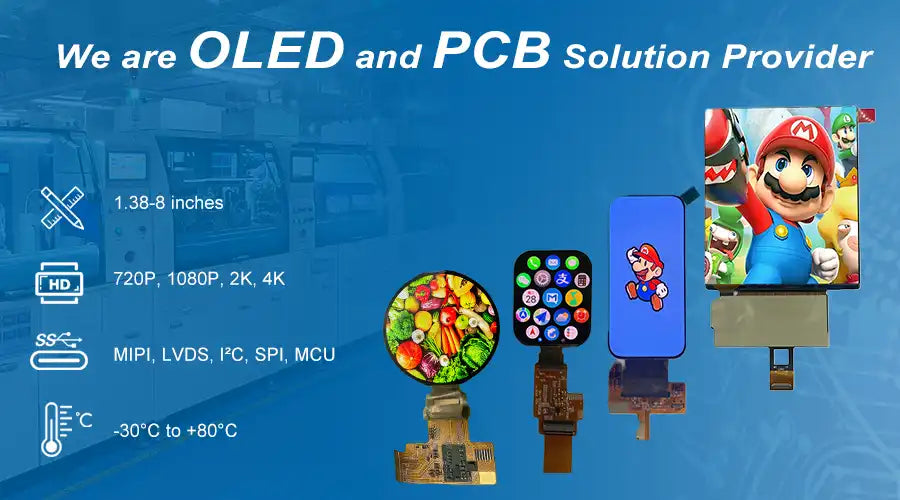
This guide explains the main differences between OLED and AMOLED in a more practical way. The two terms are often used as if they mean the same thing, but they do not. To compare them properly, it helps to look at structure, drive method, image performance, power behavior, reliability, manufacturing, and where each type makes the most sense.
Definitions: OLED vs AMOLED
OLED stands for Organic Light-Emitting Diode. It is an emissive display technology, which means each pixel produces its own light instead of relying on a backlight. That is why OLED panels are known for deep black levels, strong contrast, thin structures, and flexible design options.
AMOLED stands for Active-Matrix OLED. It is a specific form of OLED that uses a thin-film transistor backplane to control each pixel more precisely. In practice, when people talk about OLED screens in smartphones, they are usually referring to AMOLED panels.

How They Work: Device Structure and Drive
Emissive Stack and Sub-Pixel
A typical OLED structure includes several functional layers that help inject and transport charge until light is emitted from the organic material. At the image level, the display is built from red, green, and blue sub-pixels. These may be arranged in different layouts depending on the product, the manufacturing method, and the lifetime targets of the panel.
Passive-Matrix vs Active-Matrix
PMOLED uses passive row-and-column scanning and is generally suited to smaller, simpler displays. It works well for basic text, icons, and low-information interfaces. AMOLED uses a TFT backplane and a storage element at the pixel level, which allows better control, higher resolution, smoother motion, and more stable grayscale handling.
Backplane Technologies
AMOLED panels may use LTPS, LTPO, or oxide-based backplane designs depending on the application. LTPS is widely used where higher mobility and fine pixel control are important. LTPO is valued for variable refresh behavior and lower leakage in more advanced mobile products. Oxide backplanes are also important, especially where uniformity and large-area performance are priorities.
Driving and Dimming
Brightness control in OLED displays may involve analog current control, PWM, or a combination of both. Panel makers also use compensation methods to manage aging, temperature effects, and device variation over time.
Performance Comparison
Brightness and HDR
AMOLED panels generally support higher practical brightness and better HDR behavior than simpler OLED implementations because the active matrix gives tighter control over each pixel. In real products, peak brightness and sustained brightness are not the same thing. A panel may reach a very high highlight value for a short time, while full-screen brightness stays much lower because of heat and lifetime limits.
Color Gamut and Accuracy
Both OLED and AMOLED can deliver wide color gamut performance. In commercial products, AMOLED panels often include more refined calibration, white-point tuning, and compensation data. Pixel layout also affects how resolution and color performance are balanced, especially in mobile devices.
Response Time and Motion
OLED materials switch very quickly, so response performance is usually far better than conventional LCD. AMOLED takes that further by supporting high refresh rates and more advanced motion handling, which is why it is widely used in smartphones, gaming devices, and other motion-sensitive applications.
Power Consumption Models
OLED power consumption depends strongly on image content. Dark interfaces usually consume less power because black pixels emit little or no light. Bright, mostly white screens can increase power draw significantly. AMOLED panels with advanced backplanes, especially LTPO, can also reduce refresh power in static scenes.
Viewing Angle and Uniformity
OLED generally performs very well in viewing angle because it is emissive rather than backlit. Even so, wide-angle color shift and luminance non-uniformity can still appear depending on panel structure and optical tuning. Higher-end AMOLED products often use compensation and calibration to reduce these effects.

Reliability and Lifetime
OLED materials age as they are used, and blue sub-pixels usually remain the biggest lifetime challenge. When discussing reliability, it is better to ask how lifetime is measured, under what brightness, and under what image conditions. Burn-in and image retention are not just yes-or-no issues; they depend heavily on brightness, static content, thermal conditions, and usage pattern.
AMOLED panels usually include more advanced ways to manage these issues, such as pixel shifting, brightness limiting, compensation routines, and content-aware protection methods.
Environmental Robustness
OLED materials are sensitive to moisture and oxygen, so encapsulation is essential. Flexible panels often use thin-film encapsulation, while rigid panels may use glass-based sealing structures. For industrial or automotive use, front glass, adhesive choice, temperature range, and UV resistance are all part of the real durability discussion.
Manufacturing, Pixel Layouts, and Cost
AMOLED production is more complex than basic OLED module production because it combines backplane fabrication, organic deposition, encapsulation, lamination, and often touch integration. Yield, panel size, pixel density, and substrate choice all affect final cost. PMOLED is simpler and can be cheaper for small, basic modules, but it cannot match AMOLED in resolution or display complexity.
Pixel Layout Choices
- RGB stripe: Often preferred where text sharpness and full sub-pixel structure matter.
- PenTile: Common in phones, partly because it helps manage blue lifetime and manufacturing trade-offs.
- wRGB or color-filter OLED structures: More common in larger displays where manufacturing constraints differ from small mobile panels.
Cost Drivers
- Backplane complexity, especially LTPO versus simpler structures
- Rigid versus flexible substrate design
- Pixel density and panel size
- Touch integration, cover glass, and optical stack requirements
Application-Driven Selection Guide
Smartphones
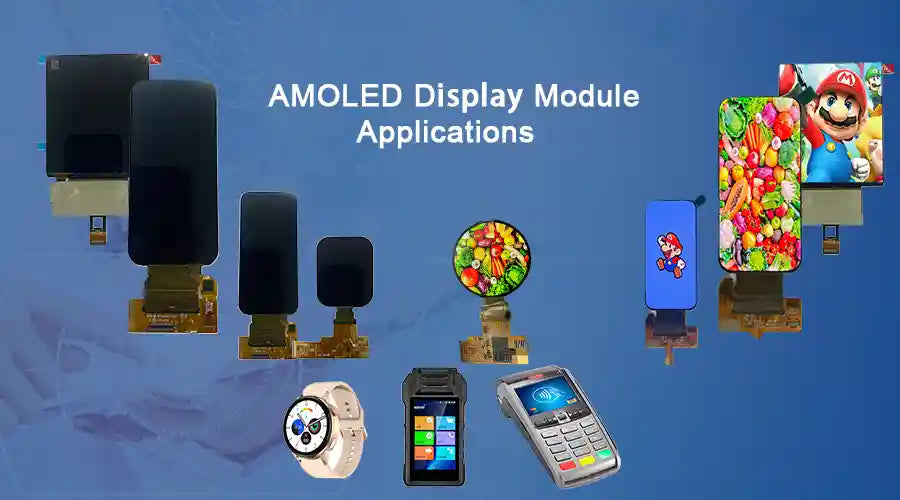
For smartphones, AMOLED is usually the better fit because it supports high resolution, fast refresh, strong contrast, and refined power management. Premium models often use LTPO AMOLED to support variable refresh rates and always-on functions more efficiently.
Wearables
Wearables often benefit from OLED or AMOLED because of thin form factor, high contrast, and freedom in shape design. PMOLED may still work in simple low-information devices, but for richer interfaces AMOLED is usually more capable.
Automotive
Automotive applications need more than image quality. Temperature, brightness stability, environmental resistance, and long-term content behavior all matter. Automotive-grade AMOLED can be a strong option, but only when the full operating profile is considered.
Industrial HMI and Signage
AMOLED can work very well in industrial HMIs with dark or mixed-content interfaces because contrast and response performance are excellent. For static, bright, always-on content, power use and uneven aging need to be reviewed carefully. In some cases, LCD or other technologies may still be more practical.
Medical and Scientific
In these applications, color accuracy, uniformity, and controlled brightness may matter more than headline contrast. If AMOLED is used, calibration data, white point control, and panel consistency should all be part of the evaluation.

Side-by-Side Comparison Table
| Category | OLED (General / PMOLED) | AMOLED (Active-Matrix) |
|---|---|---|
| Drive scheme | Passive row and column scanning | TFT-based per-pixel control |
| Resolution | Lower, suited to simple small displays | High, suitable for dense modern panels |
| Motion performance | Basic animation and simple motion | High refresh and smoother moving content |
| Brightness and HDR | More limited | Stronger overall control and better HDR potential |
| Power behavior | Efficient for dark, simple interfaces | More optimized in advanced mobile use cases |
| Uniformity and calibration | Usually simpler | Usually more refined |
| Typical uses | Indicators, compact modules, simple wearable screens | Phones, watches, automotive, XR, advanced interfaces |
| Cost | Lower for simple small modules | Higher because of process complexity |
FAQ
Is AMOLED always better than OLED?
Not always. AMOLED is usually better for high-resolution, video-capable, or touch-rich products. For very small and simple displays, basic OLED solutions can still be more practical and lower in cost.
Which lasts longer: OLED or AMOLED?
Lifetime depends more on materials, drive condition, brightness, and thermal control than on the label alone. In many real products, AMOLED lasts better because it includes more advanced control and compensation methods.
Why do some AMOLED phones use PenTile layouts?
PenTile layouts are used partly to manage lifetime and manufacturing trade-offs, especially around blue sub-pixels, while still maintaining good perceived sharpness.
Does dark mode save power on AMOLED?
Yes, in most cases it does. OLED power use depends on how much light the screen produces, so darker interfaces usually reduce power draw.
Can AMOLED be used for bright, static signage?
It can, but the application needs careful planning. Static bright content increases the risk of uneven aging, so UI design and usage pattern matter a lot.
Conclusion and Next Steps
In simple terms, AMOLED is the more advanced and more capable form of OLED for most modern high-resolution display products. Basic OLED still has a place in smaller and simpler modules, especially where low complexity matters more than advanced image performance. The right choice depends less on branding and more on actual requirements: size, brightness, UI style, power profile, refresh behavior, operating conditions, and lifetime target.
- Share the target size, resolution, and brightness level.
- Describe whether the UI is mostly dark or mostly bright.
- Include refresh needs, operating temperature, and duty cycle.
- Then compare OLED and AMOLED options against real use conditions instead of headline specs alone.


コメントを書く
このサイトはhCaptchaによって保護されており、hCaptchaプライバシーポリシーおよび利用規約が適用されます。