
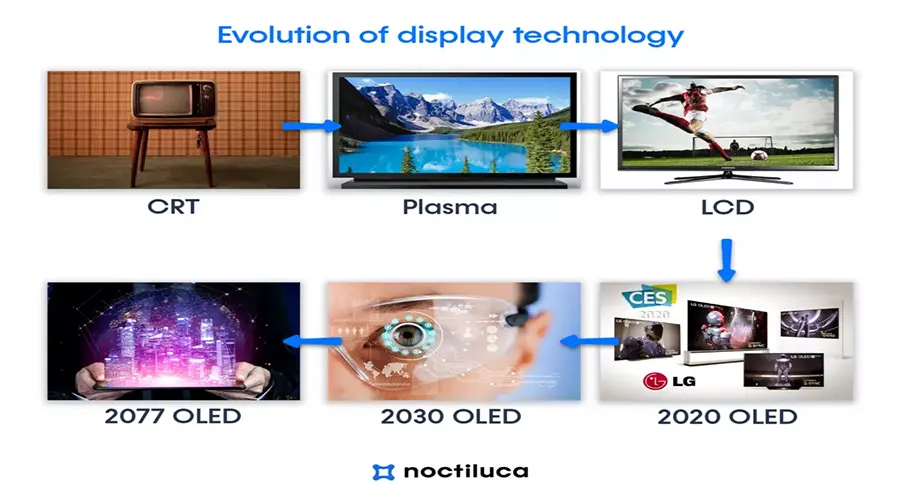
Learn the working principles, key advantages, display types, B2B applications, technology comparisons, and engineering specs that matter when selecting an OLED display.

OLED Displays are self-emissive screens where each pixel lights independently. This enables ultra-thin modules, premium image quality, strong dark-UI power behavior, and flexible industrial form factors, making OLED valuable in next-generation industrial, wearable, automotive, and retail devices.
TL;DR — Quick Engineering Summary
- Self-emitting pixels mean no backlight, true black, and very high contrast
- Ultra-thin form factors support flexible, curved, and transparent designs
- Fast response and wide viewing angles suit motion UI and video
- Outdoor visibility depends on brightness together with AR films and optics
- Static UI can create burn-in risk, so firmware and UI mitigation matter
1) What Is an OLED Display? (Principles and Types)
How OLED Emits Light
Each pixel contains organic semiconductor material. When voltage is applied, the material emits light directly, which enables true black and high contrast without using a backlight unit.
Main Types
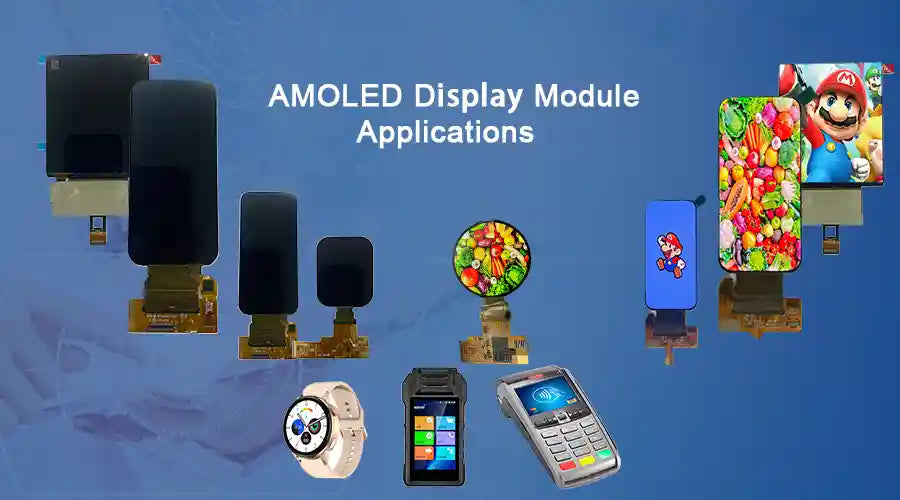
- AMOLED — active-matrix OLED with TFT backplane, suited for higher resolution and larger modules
- PMOLED — passive-matrix OLED, better suited to smaller display areas and simpler UI content

Form Factors
- Flexible and curved OLED
- Foldable OLED
- Transparent OLED
2) Key Advantages and Engineering Considerations
Advantages
- True black and very high contrast from pixel-level OFF state
- Ultra-light and ultra-thin structure without a backlight stack
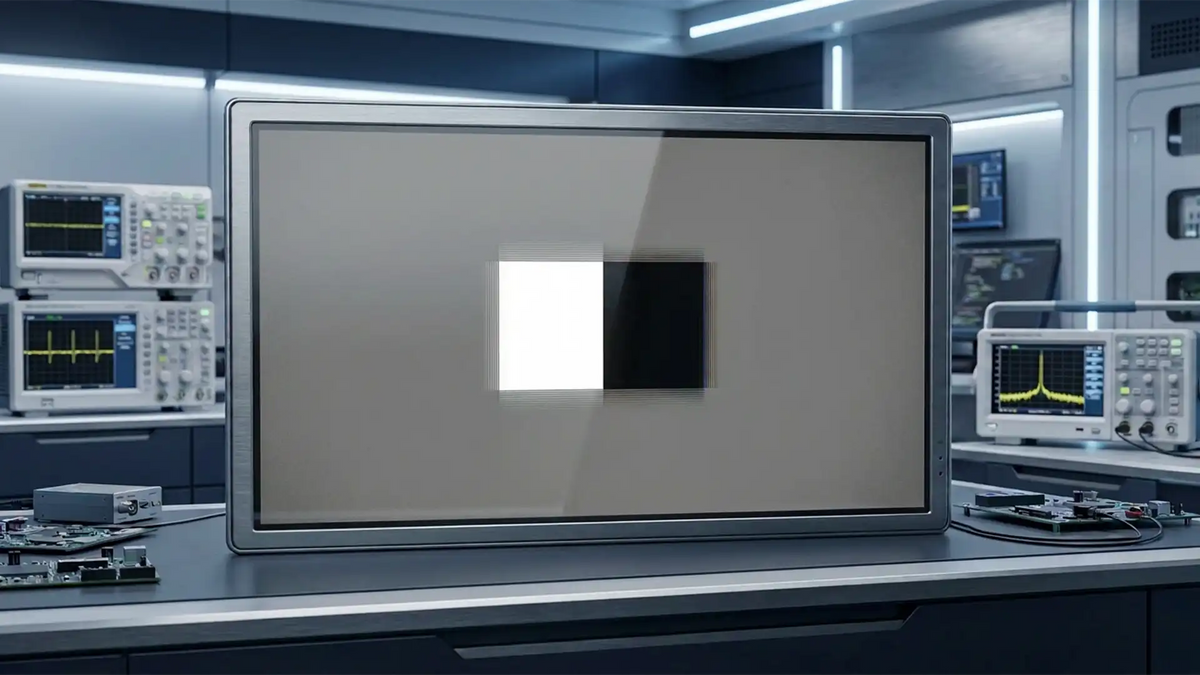
- Faster response than LCD, useful for animation and real-time UI
- Wide viewing angle and strong color saturation
Limitations
- Peak brightness may be lower than MiniLED in strong direct sunlight use cases
- Burn-in risk exists in static UI scenarios and requires compensation strategy
- Large size or special-shape variants can cost more

3) OLED Display Applications
- Industrial HMI — better readability and thin design in compact devices
- Automotive — curved cockpit displays and wide-temperature designs
- Wearables — dark UI power savings and comfortable form factors
- Medical and instruments — strong contrast for critical data visualization
- Smart retail and transparent signage
| Industry | OLED Benefit | Key Requirement |
|---|---|---|
| Industrial HMI | Readability, thin design | -20 to 70 °C, impact-resistant cover |
| Automotive | Curved cockpit display | Wide-temperature range |
| Wearables | Ultra-low power with dark UI | Small size, SPI or I²C options |
4) OLED vs LCD / MiniLED / MicroLED

| Feature | OLED | MiniLED LCD | MicroLED |
|---|---|---|---|
| Black and contrast | Excellent | Very strong, but not pixel-off perfect | Excellent |
| Thickness | Ultra-thin | Thicker | Thin |
| Peak brightness | Medium to high depending on design | High | Very high |
| Static UI risk | Burn-in must be managed | No OLED-type burn-in | No OLED-type burn-in |
5) Key Specs and B2B Selection Guide
Must-Check Engineering Specs
- Size and resolution
- Brightness together with polarizer or AR coating strategy
- Refresh rate and response behavior
- Interface such as MIPI, eDP, LVDS, or SPI
- Power consumption relative to UI usage pattern
- Operating temperature range for industrial or automotive grade
- Touch integration method such as On-Cell or OGS
Conclusion
OLED Display is one of the strongest display solutions for products that require premium UX, fast motion handling, thin form factor, and strong energy behavior under dark UI conditions. For very high-brightness outdoor products or extremely long-lifetime use cases, hybrid or alternative display strategies may still be worth evaluating.
Send your requirements — size, brightness, interface, and environment — and we can align the display path to your project needs.
FAQ: Common B2B Questions
Is OLED suitable for outdoor sunlight?
Will OLED burn-in?
Can OLED reduce power?

コメントを書く
このサイトはhCaptchaによって保護されており、hCaptchaプライバシーポリシーおよび利用規約が適用されます。