

TFT LCD Display Module Guide
A structured guide to how TFT LCD display modules work, their advantages, common panel types, applications, future trends, and how to choose the right module for your project.
Introduction
TFT LCD display modules are deeply integrated into daily life, from smartphones and tablets to televisions, industrial equipment, and digital signage. These modules are one of the most common display technologies used across consumer and professional products because they offer a practical combination of resolution, cost structure, image quality, and manufacturing maturity.
TFT stands for Thin Film Transistor, and LCD stands for Liquid Crystal Display. When these technologies are combined, they create active-matrix displays capable of producing clear images, stable control at the pixel level, and broad usability across many electronic products.

The Thin Film Transistor Liquid Crystal Display module remains a mainstream display technology. Its core structure relies on the interaction between thin-film transistors, liquid crystal material, polarizers, color filters, and a backlight system to create visible images.
How TFT LCD Display Modules Work
The working process of a TFT LCD display module can be understood step by step:
- Backlight system: the display starts with a backlight source behind the panel. This provides the light that the LCD stack will modulate.
- Polarized light: the emitted light passes through the first polarizer, which organizes the light into a defined polarization direction.
- Liquid crystal layer: liquid crystal molecules rotate or alter light transmission behavior when influenced by an electric field.
- Color filter: the light then passes through red, green, and blue subpixel filters that generate full-color images.
- Second polarizer: a second polarizer helps determine how much light finally exits the display stack.
- Thin film transistor control: each pixel is controlled by TFT circuitry that manages the charge level and therefore the optical state of the liquid crystal.
Liquid crystal molecules do not generate light themselves. Instead, they function as a controllable optical shutter system, while the actual light source remains the backlight behind the panel.

Advantages of TFT LCD Display Modules
- Crisp imagery and accurate colors: TFT active-matrix control supports clear and stable image rendering.
- Fast response and strong contrast: many TFT LCD modules are suitable for responsive interfaces and moving content.
- Wide viewing angles and high resolution options: especially with panel technologies such as IPS.
- Energy efficiency and versatility: TFT LCD modules are widely used because they balance performance and practicality well.
- Durability and interactive compatibility: many TFT modules are used with touch systems in consumer and industrial products.
These characteristics help explain why TFT LCD remains one of the most mature and broadly adopted display technologies in the market.

Applications of TFT LCD Display Modules
- Consumer electronics: widely used in smartphones, tablets, cameras, and many portable products.
- Automotive and industrial control: used in dashboards, control panels, navigation systems, and equipment interfaces.
- Medical and home appliances: supports visualization in monitoring, diagnostics, and smart-device interfaces.
- Retail and information display: common in POS systems, self-service terminals, and public information displays.
- Education and entertainment: used in interactive learning tools, gaming products, and home entertainment systems.
TFT LCD technology has become deeply embedded across many industries because it supports both high-volume consumer products and more demanding professional applications.
Conclusion of application value: TFT LCD display modules have significantly improved user interaction, data visibility, and visual communication across modern products and systems.

TFT LCD Display Module Types and Features
1. TN TFT Displays
Features:
- Fast response behavior
- Usually lower cost
- Often higher brightness efficiency
- More limited viewing angles and color performance compared with IPS
2. IPS TFT Displays
Features:
- Wide viewing angles
- Better color consistency and accuracy
- Well suited for products where image quality matters
- Often more expensive than TN
3. VA TFT Displays
Features:
- Strong contrast performance
- Good color reproduction
- Viewing angles better than TN but generally different from IPS behavior
- Can show color shifting at more extreme angles
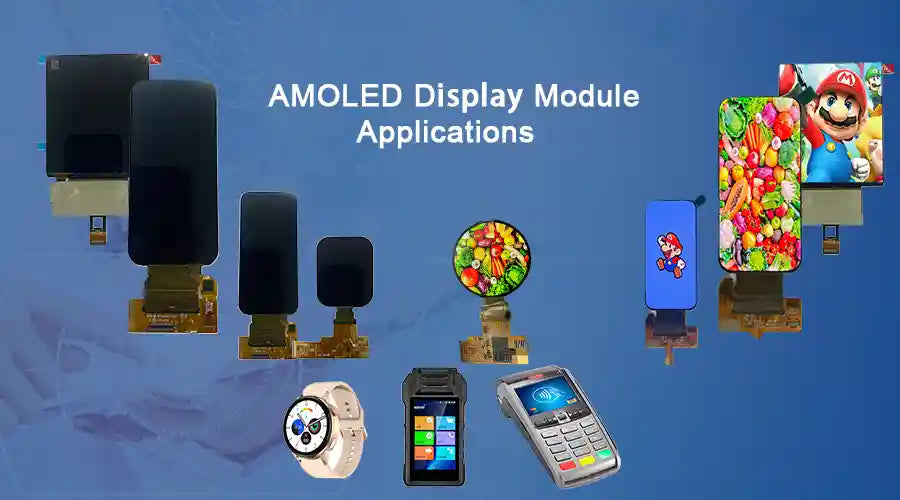
4. AMOLED and OLED Active-Matrix Displays
Features:
- Not TFT LCD in the strict optical sense, but related through active-matrix control concepts
- Very high contrast with true black
- Strong color and viewing-angle performance
- Generally higher cost and possible long-term burn-in concerns
Important Features to Consider
- Resolution: affects image sharpness and detail
- Size: affects mechanical integration and viewing distance suitability
- Brightness: especially important for outdoor or bright environments
- Contrast ratio: affects perceived depth and image vividness
- Viewing angle: important for shared viewing or off-axis use
- Color depth: affects realism and gradient quality
- Power consumption: critical in battery-driven products
- Response time: important for fast-moving graphics and video
When selecting a TFT display module, the correct choice depends on the actual application and which trade-offs matter most.
How to Choose the Right TFT LCD Display Module for Your Project
- Size and resolution selection: should be based on industrial design, UI density, and image clarity needs.
- Panel type selection: TN, IPS, and VA each offer different balances of cost, color, and viewing performance.
- Brightness and contrast: especially important in outdoor or high-ambient-light conditions.
- Interface and power consumption: the module must match the host platform and system power goals.
- Operating environment and budget: temperature, humidity, reliability needs, and project cost all affect the final choice.
Each of these choices should be based on a clear understanding of product requirements, intended use conditions, and user expectations.

Future Trends in TFT LCD Display Module Technology
- Higher resolution and pixel density: continued improvements beyond mainstream high-definition standards.
- Improved energy efficiency: driven by better backlight systems and improved power management.
- More advanced touch integration: increasingly important for interactive product design.
- AR and VR compatibility: new use cases may require faster refresh and reduced latency.
- Environmental sustainability: materials and manufacturing processes are expected to improve in environmental performance.
TFT LCD display module technology continues to evolve in resolution, efficiency, touch integration, and broader system adaptability. Sustainable manufacturing and better performance remain important long-term directions.

Leading TFT LCD Display Suppliers Worldwide
Below is a general overview of major companies often associated with TFT LCD display technology:
- LG Display
- Samsung Display
- Innolux Corporation
- AU Optronics
- BOE Technology Group
- Sharp Corporation
- Tianma Microelectronics
- Japan Display Inc.
- Chunghwa Picture Tubes
- HannStar Display Corporation

Conclusion
TFT LCD display modules have changed the way users interact with visual information across consumer, industrial, automotive, retail, medical, and educational products. Understanding how they work, what advantages they provide, and how different panel types behave makes it much easier to select the right display for a project.
When choosing a module, it is important to consider size, resolution, interface compatibility, operating environment, power behavior, and budget. Each of these factors influences the final user experience and the technical suitability of the display.
As display technology continues to improve, TFT LCD modules are expected to remain highly relevant, especially where strong manufacturability, flexible options, and broad system compatibility are important.
For more information and to explore the latest TFT LCD display module options, visit our website or contact our team for support.


Leave a comment
This site is protected by hCaptcha and the hCaptcha Privacy Policy and Terms of Service apply.