

E-Paper technology often attracts attention because of its low power consumption and paper-like readability, but the real question for product teams is not whether the technology is interesting. The more important question is whether it fits the actual application. In B2B projects, application fit matters more than technology hype. A display only creates value when it supports the real operating environment, the update pattern, the user behavior, and the maintenance model of the product.
E-Paper works best when information needs to remain readable, stable, and power-sensitive. That is why it has become increasingly relevant across industries such as retail, industrial systems, healthcare, office signage, logistics, and smart devices. In this guide, we will look at how E-Paper is used in different industries, why it performs well in certain scenarios, and how to match the right E-Paper module to the needs of each application.
Why E-Paper Fits So Many Industries
E-Paper is not a universal replacement for every display technology, but it fits many industries because its strengths align with a large number of practical business needs. In many professional environments, the goal is not fast animation or rich media. The goal is to present stable information clearly, efficiently, and with minimal maintenance.
Low Power Operation
One of the biggest reasons industries adopt E-Paper is power efficiency. In many designs, the display mainly consumes power when content changes. This helps reduce battery replacement frequency and supports low-maintenance deployment in distributed systems.
High Ambient-Light Readability
Because E-Paper is reflective, it performs well in bright indoor environments and can remain highly readable under strong ambient light. This makes it practical for retail floors, office buildings, healthcare spaces, warehouses, and selected public information areas.
Clean and Quiet Visual Presentation
E-Paper is well suited for interfaces that need to feel simple, calm, and information-focused. In many B2B applications, this is a benefit rather than a limitation because the display is meant to communicate essential information instead of attracting attention through motion.
Flexible Integration in Connected Devices
As more industries adopt connected labels, sensors, smart signs, and low-power interfaces, E-Paper becomes easier to integrate into practical product ecosystems. It can serve as an efficient visual layer in systems where wireless connectivity and long operating life are both important.
Core principle: E-Paper creates the most value where information changes occasionally, must stay visible clearly, and should not require continuous power.
Retail Applications
Retail is one of the strongest and most established application areas for E-Paper displays. Stores need clear product communication, efficient information updates, and scalable deployment across large numbers of display points.
Electronic Shelf Labels
Electronic shelf labels are one of the most common uses of E-Paper in retail. They display prices, product names, promotions, stock cues, and product details while maintaining long battery life and strong readability across the store environment.
Promotional Labels
Color E-Paper can improve promotional visibility by highlighting discounts, campaigns, membership pricing, or featured products. This helps retailers combine low-power operation with stronger merchandising communication.
Smart Pricing Systems
In connected retail systems, E-Paper supports centralized pricing updates and reduces the need for manual label replacement. This improves efficiency and helps maintain pricing consistency across shelves and product categories.
Product Category Communication
E-Paper labels can also help separate product groups, show category markers, or display short product attributes. This is useful in stores where clean navigation and fast product identification improve the customer experience.
Industrial Applications
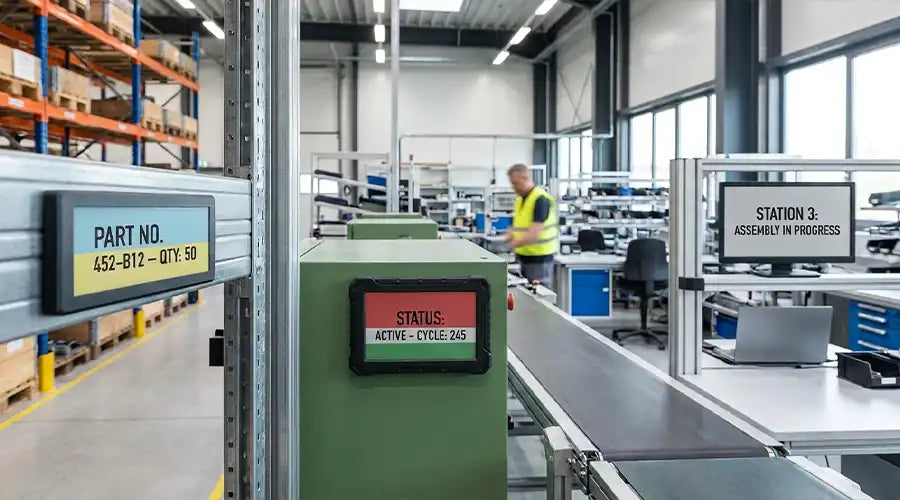
Industrial applications often require practical information display rather than multimedia output. In these environments, E-Paper can support clear status communication while reducing power demand and simplifying device operation.
Instrument Status Displays
Equipment and instruments may use E-Paper for machine status, operating states, process values, or service information. If the content updates periodically rather than continuously, E-Paper can be a strong fit.
Production Line Indicators
Production areas may use E-Paper for station identification, work instructions, status panels, or process labels. The paper-like readability helps operators view information clearly under bright indoor lighting.
Warehouse Labels
In industrial and warehouse environments, E-Paper can be used for rack labels, storage identification, inventory positions, and operational tags. Because these labels often remain static for long periods, the technology is well suited to the task.
Portable Industrial Equipment Interfaces
Battery-powered handheld devices, diagnostic tools, and specialized industrial products may use E-Paper when the interface is text-focused and low-power operation is a higher priority than fast animation.

Medical and Healthcare Applications
Healthcare environments value clear presentation, organized information, low maintenance, and reliable visibility. E-Paper can support these needs in several practical ways.
Bedside Information Panels
Bedside panels can use E-Paper to display room information, patient-related status categories, care reminders, or workflow data in a readable and uncluttered format.
Medical Labels and Status Displays
Medical labeling applications may include equipment status tags, department indicators, portable asset labels, or identification panels where readable static information is more important than active graphics.
Portable Healthcare Equipment
Battery-powered healthcare devices can benefit from E-Paper when they need to display stable information efficiently over long operating periods. This is especially relevant in products that are checked frequently but updated only occasionally.
Easy-to-Read Information Presentation
The paper-like appearance of E-Paper can help present important information clearly, especially in spaces where the content is read repeatedly and visual simplicity is beneficial.
Office and Commercial Building Applications
Office environments are another strong fit for E-Paper, especially where digital information needs to remain visible without requiring constant power or high-maintenance screen systems.
Meeting Room Signs
Meeting room scheduling displays are a common use case. They can show room availability, booking information, department use, or timing details while remaining clear and easy to read from the corridor.
Desk Nameplates
E-Paper can be used for employee desk labels, flexible seating systems, visitor desk assignments, or smart workspace identification where names and roles change occasionally.
Visitor Guidance Signs
Commercial buildings may use E-Paper for floor navigation, visitor instructions, reception guidance, and directional labels. Color E-Paper can be useful when emphasis or department coding is needed.
Smart Scheduling Interfaces
In offices and shared spaces, E-Paper can help modernize scheduling and room management systems while keeping the interface minimalist and low power.
Logistics and Warehousing Applications
Logistics environments often need many display points, low maintenance, and dependable readability. These requirements make E-Paper a practical technology for various warehousing and distribution tasks.
Shelf Identification
Shelves and storage locations can use E-Paper for clear labeling that remains visible for long periods without frequent service.
Bin Labels
Bins, containers, and picking zones may use E-Paper labels for product IDs, quantities, workflow codes, or temporary assignment data. The low-power nature of the display is especially useful in large facilities.
Pick-and-Pack Support
In selected logistics systems, E-Paper can support pick-and-pack operations through location information, status indicators, or process guidance where simple visual updates are enough.
Low-Maintenance Information Updates
Warehousing projects often prioritize reduced manual labor and long service intervals. E-Paper helps by supporting readable, stable updates without the continuous power needs of many active display systems.
Smart Home and Consumer Device Applications
Although much of the strongest E-Paper demand is in B2B, the technology also has value in smart home and selected consumer-oriented products where calm interfaces and battery efficiency are priorities.
Home Control Panels
Minimalist control panels that display room status, mode information, or simple home system data can use E-Paper when rich animation is not required.
Appliance Information Windows
Household devices may use E-Paper for settings, status windows, reminders, or persistent information surfaces where stable readability matters more than media-style graphics.
Battery-Powered Companion Displays
Companion displays for sensors, thermostats, smart accessories, or connected low-power products can benefit from E-Paper because it supports long operating life while keeping essential information visible.
Minimalist User Interfaces
Some products intentionally avoid bright, highly dynamic screens in favor of cleaner interfaces. E-Paper fits well in this design direction, especially for information-first user experiences.
Outdoor and Public Information Applications
E-Paper can also be useful in selected public information and semi-outdoor scenarios, especially where readability in bright environments and low power operation are more important than dynamic multimedia behavior.
Semi-Outdoor Signage
Covered entrances, public corridors, campus spaces, and building exteriors with controlled exposure can use E-Paper signage for schedules, notices, and informational updates depending on the overall enclosure and protection design.
Transit and Schedule Displays
Some schedule-related applications can use E-Paper when updates occur at intervals and the priority is clear readability rather than constant animation.
Community Information Boards
Shared spaces such as residential buildings, campuses, and public service areas may use E-Paper boards for announcements, event details, or practical notices where energy efficiency and visibility are valuable.
Visibility in Bright Environments
One reason E-Paper works well in these scenarios is its reflective readability. In bright light, it can remain comfortable to read, although final suitability still depends on housing design, temperature requirements, and update expectations.

How to Match Industry Needs with the Right E-Paper Module
The same E-Paper module is not ideal for every industry. Selection should be based on how the display will actually be used.
Screen Size
Small modules may work well for labels and tags, while medium and large sizes are better for room signs, public information boards, and equipment panels. The size should match both content density and viewing distance.
Monochrome vs Color
Monochrome E-Paper is often the strongest choice for essential text, numbers, and operational information. Color E-Paper is better when promotions, category coding, public-facing communication, or stronger visual hierarchy are needed.
Update Interval
E-Paper works best when content changes occasionally or at predictable intervals. Applications requiring constant rapid visual change are usually better served by other display technologies.
Durability Needs
Industrial, logistics, healthcare, and public building projects may all have different durability priorities. Front-surface protection, mounting design, enclosure fit, and environmental planning should match the operating environment.
Integration Environment
The final selection should also consider interface requirements, power architecture, wireless connectivity strategy, and whether the product needs touch, cover lens integration, or custom structural design.
Conclusion
E-Paper is not the right choice for every display project, but it is highly effective in the right application. Its strengths in low power consumption, bright-light readability, stable information display, and clean visual presentation make it valuable across retail, industrial systems, healthcare, office signage, logistics, and selected public information use cases.
The best results come when industry requirements drive module selection. Rather than starting with the technology itself, product teams should begin with the use case, the update pattern, the installation environment, and the maintenance goals. Once those needs are clear, it becomes much easier to determine whether E-Paper is the right fit and which type of module will deliver the best long-term value.
Looking for the Right E-Paper Display for Your Industry?
If you are evaluating E-Paper solutions for retail, industrial, healthcare, office signage, logistics, or OEM applications, you can build internal links here to your category pages, custom module pages, or inquiry page.
Suggested internal links: E-Paper Collection / Color E-Paper / Black and White E-Paper / Custom E-Paper Modules / Contact Us
FAQ
Which industry uses E-Paper the most?
Retail is one of the most established industries for E-Paper, especially through electronic shelf labels and smart pricing systems. However, industrial, healthcare, office signage, and logistics applications are also growing because they benefit from readable low-power information display.
Is E-Paper good for industrial equipment?
Yes, E-Paper can be a good choice for industrial equipment when the screen mainly shows stable status information, labels, or periodic updates. It is especially useful where low power and high readability are more important than fast graphics.
Can E-Paper be used in hospitals?
Yes, E-Paper can be used in hospitals and healthcare environments for bedside information panels, equipment labels, identification displays, and other readable low-maintenance information surfaces. Final suitability depends on the full device design and environmental requirements.
Is E-Paper suitable for office signage?
Yes, E-Paper is very suitable for office signage such as meeting room signs, desk nameplates, visitor guidance panels, and scheduling displays because these applications usually update periodically rather than continuously.
What type of E-Paper is best for retail?
The best type depends on the retail use case. Black and white E-Paper is often suitable for standard price labels and simple product information, while color E-Paper is better when promotions, category emphasis, or stronger visual communication are needed.
How do I choose the right E-Paper module for an industry application?
Start by reviewing the screen size, content type, update interval, power requirements, environmental conditions, and whether the display needs color, touch, or custom mechanical design. The correct module should match the operational needs of the industry, not just the display specification.


Leave a comment
This site is protected by hCaptcha and the hCaptcha Privacy Policy and Terms of Service apply.