
Engineering Guide
Engineering Guide for Product Designers, OEM/ODM Teams and Procurement
Engineering Guide for Product Designers, OEM/ODM Teams & Procurement
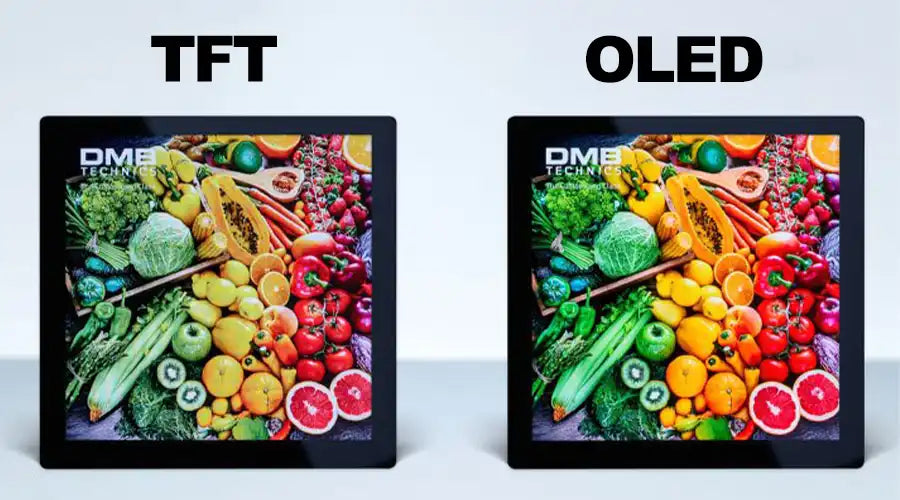
Selecting the right display module is a critical decision that impacts product user experience, industrial design, power budget, reliability, and total cost of ownership. In 2025, OLED and TFT LCD remain the two dominant display technologies for embedded applications, from wearables to automotive cockpits. This guide provides a detailed, engineer-focused comparison to help you choose the optimal solution for your next project.

1. Introduction — Why Display Selection Matters
The role of displays in modern IoT, industrial, automotive, and consumer devices
Today’s displays are no longer passive output devices. They are central to user interaction, brand perception, and system efficiency. Whether it is a medical monitor showing vital signs or a factory HMI controlling machinery, the display directly affects usability, safety, and service life.
Why OLED and TFT LCD are the two mainstream module technologies
While MicroLED and E-Ink serve niche roles, OLED and TFT LCD dominate mid-to-high-end embedded markets because of mature manufacturing, scalable sizes, and flexible integration options.
Overview of selection challenges
Key trade-offs include:
- Power consumption under real-world UI patterns
- Sunlight readability versus indoor contrast
- Risk of image retention or burn-in
- Mechanical constraints such as curved, ultra-thin, or rugged structures
- Total cost at volume, including yield and supply stability
2. What Is an OLED Display Module?
Definition: self-emissive organic diode display
An OLED display generates light directly from organic emissive layers, with no backlight required. Each pixel emits its own light and can be turned completely off, enabling true black and very high contrast.
Structure: TFT backplane and organic stack
Modern OLED modules typically use an active-matrix architecture with an LTPS or IGZO TFT backplane to drive individual pixels. The organic emissive stack is sealed with thin-film encapsulation to reduce moisture and oxygen ingress risk.
Variants: AMOLED, flexible OLED, transparent OLED
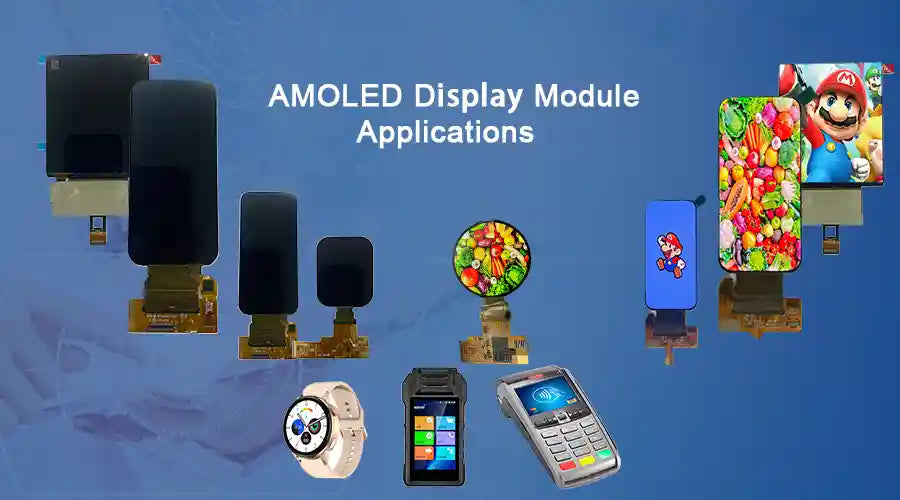
While PMOLED exists for very small indicators, most B2B applications use AMOLED. Advanced variants include flexible OLED for curved or foldable designs and transparent OLED for retail showcases or HUD-related applications.
Typical module integration
A complete OLED module may include:
- FPC with driver IC
- Optional on-cell or OGS touch sensor
- Cover glass with AR or AG coating
- Circular polarizer for glare reduction

3. What Is a TFT LCD Module?
Definition: liquid crystal and backlight architecture
TFT LCD uses a liquid crystal layer to modulate light from a separate backlight unit. Pixels do not emit light. They function as shutters that control transmitted light.
Structure: TFT matrix, LC cell, polarizers, and BLU
The core stack generally includes a color filter, liquid crystal layer, glass substrates, front and rear polarizers, LED backlight, and a TFT array for pixel control.
IPS, VA, and TN LCD differences
- IPS: strong viewing angles and color accuracy, common in premium HMIs
- VA: higher contrast than IPS but narrower viewing angle
- TN: lower cost and fast response, but weaker color and viewing performance
Integration components
Standard TFT LCD modules often include:
- LED backlight with diffuser and optical films
- FPC with timing controller
- Optional resistive or capacitive touch layer
- Chemically strengthened cover glass

4. Key Technical Differences (OLED vs TFT LCD)
The table below summarizes critical performance parameters:
| Parameter | OLED Display Module | TFT LCD Module |
|---|---|---|
| Light-emitting mechanism | Self-emissive with no backlight | Requires LED backlight |
| Thickness | Ultra-thin module structure | Thicker because of the backlight stack |
| Black level and contrast | True black and very high contrast | Lower black depth, lower native contrast |
| Brightness | Strong indoor performance, can be engineered higher | High brightness more easily scalable for sunlight use |
| Color gamut | Wide gamut capability | Typically sRGB-oriented, wider gamut possible with advanced stacks |
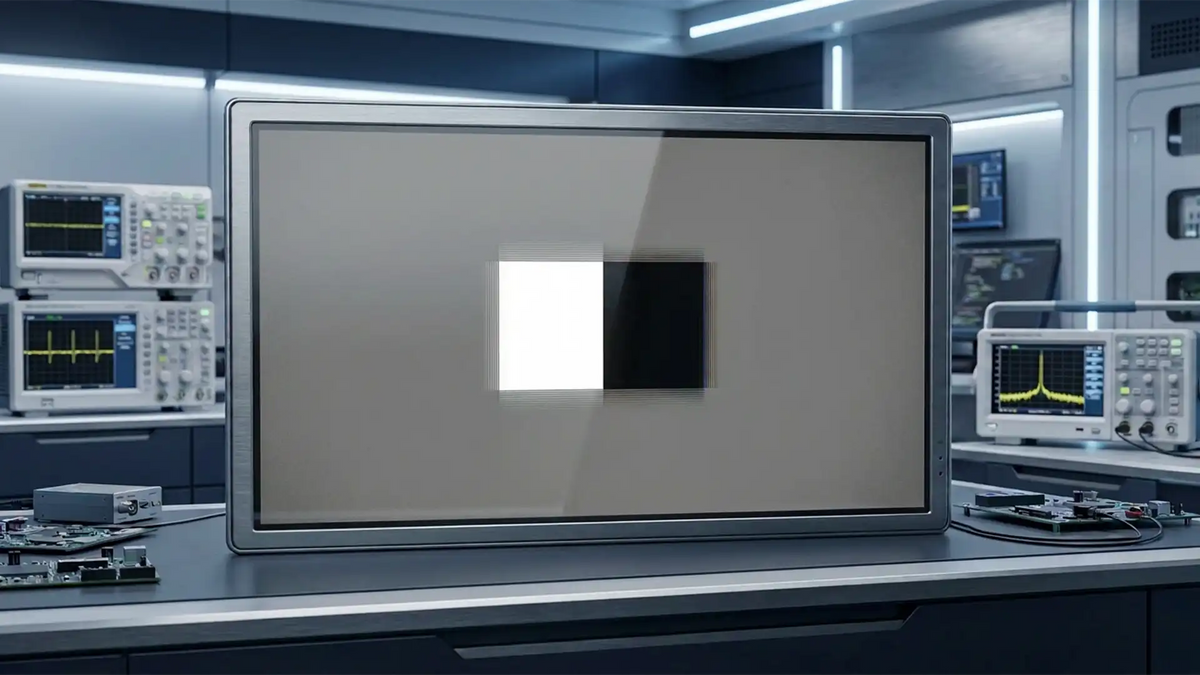
| Response time | Very fast | Slower than OLED |
| Viewing angle | Very wide with limited shift | Depends on IPS, VA, or TN mode |
| Power with dark UI | Very efficient | Backlight remains active |
| Power with white UI | Can be higher than LCD | Often more favorable |
| Lifespan | Organic material aging must be considered | Backlight aging dominates long-term behavior |
| Burn-in risk | Yes, under static high-brightness content | No OLED-type burn-in |
| Operating temperature | Industrial and automotive grades available | Widely available across wide temperature ranges |
| Form factor | Flexible, curved, transparent options possible | Primarily rigid |
| Cost | Higher in many size bands | Lower and highly competitive |
5. Advantages of OLED Display Modules
- Ultra-high contrast: deep blacks improve visual depth and perceived image quality
- Thinner and lighter: useful for slim product profiles and reduced stack height
- Fast response: suitable for dynamic UIs, video, gaming, and AR or VR-related motion demands
- Design freedom: supports curved, flexible, and transparent implementations
- Wide viewing angle: color and brightness remain more consistent at angle
- Energy-efficient on dark UIs: especially useful in battery-powered products
6. Advantages of TFT LCD Modules
- Higher peak brightness: better fit for outdoor and sunlit environments
- No burn-in: safer for static gauges, dashboards, and status displays
- Lower cost: especially competitive at larger sizes and scale volumes
- Wide temperature availability: strong option for industrial-grade designs
- Long-term stability: proven in long-life deployments such as medical, kiosk, and industrial systems
- Mature supply chain: many vendors, easier second-source strategies

7. Application Scenarios: Which Technology Fits Your Product?
- Consumer electronics: smartphones and smartwatches often favor OLED for aesthetics and dark-UI efficiency
- Automotive displays: center stacks may prefer OLED for design, while clusters may favor high-brightness LCD or qualified OLED with compensation
- Industrial HMI: factory machines and test equipment often favor TFT LCD because of static UI behavior and reliability priorities
- Medical devices: non-diagnostic displays may benefit from OLED, while diagnostic systems often rely on calibrated LCD
- Retail signage: transparent shop windows may use transparent OLED, while outdoor signage generally favors high-brightness LCD
- IoT devices: battery-powered products with dark UI may suit OLED, while always-on white UI may suit LCD
- AR or VR: near-eye applications often move toward Micro-OLED
8. Cost Analysis: OLED vs TFT LCD
Module cost by size
- Small sizes: OLED usually carries a noticeable premium versus LCD
- Mid sizes: price gap remains significant in many B2B projects
- Larger sizes: LCD is often substantially more cost-competitive
Factors influencing pricing
- Backplane type: LTPS OLED often costs more than mainstream LCD backplanes
- Brightness target: higher luminance increases module complexity and cost
- Touch integration: cover lens, bonding, and touch stack influence final BOM
- Yield rate: OLED can be more sensitive in large or flexible panel manufacturing
- Supply chain: LCD usually offers broader sourcing flexibility
Long-term cost considerations
Although OLED has a higher initial module cost, it can reduce some system-level constraints by enabling thinner product design or optimizing dark-UI battery behavior. For high-volume products with static content and aggressive cost targets, LCD often remains the more economical choice.

9. Reliability and Lifespan Considerations
- OLED burn-in: mitigate with pixel shifting, logo dimming, and brightness management
- Luminance decay: evaluate lifetime behavior against your actual use case and brightness target
- LCD backlight decay: dimming and color shift occur over time, but are well understood
- Temperature performance: low temperature affects OLED efficiency and can slow LCD response
- Moisture sensitivity: OLED needs strong encapsulation strategy, while LCD still requires proper sealing
10. Engineering Selection Guide (Checklist)
Ask these questions before finalizing your display:
- Will the UI be mostly dark or mostly white and static?
- What is the ambient lighting condition: indoor, outdoor, or variable?
- Do you need curved, flexible, or transparent form factors?
- What is your power budget per hour or per day?
- What is the expected product lifetime?
- Do you require touch, and if so, what integration method is preferred?
- What interface does your SoC support, such as MIPI DSI, LVDS, eDP, or SPI?
- What is your target BOM cost at planned production volume?
- Will the device operate in extreme temperatures or high humidity?

11. Conclusion — Which Is Better for Your Product?
- Choose OLED if design elegance, contrast, thinness, fast motion, or dark-UI power savings are priorities.
- Choose TFT LCD if you need high brightness, static-content safety, broad temperature availability, lower cost, or long-term field stability.
- In practical B2B selection, the best choice should be driven by application requirements, not by trend alone.
12. Contact Us for OLED / LCD Modules
We supply industrial-grade OLED and TFT LCD display modules from small to large sizes, with full customization options for engineering projects.
- Full datasheets and interface specifications
- Engineering samples for validation
- Custom sizes, brightness, touch, and FPC routing support
- Long-term supply planning with EOL policy support
FAQ (B2B Engineer Questions)
Can OLED displays be used in industrial environments?
Yes, with suitable encapsulation, thermal design, and UI strategy. Industrial-grade OLED modules can be specified for demanding environments when lifetime and static-content risks are properly managed.
Does OLED really save power?
It depends on the UI pattern. Dark interfaces can significantly reduce OLED power draw, while bright or white-heavy screens may consume more power than LCD.
How do I prevent OLED burn-in in a status display?
Use periodic pixel shift, brightness limiting, timeout-based UI changes, and avoid static high-brightness elements wherever possible.
Is MIPI DSI supported on both OLED and LCD?
Yes. Many modern AMOLED and TFT LCD modules support MIPI DSI, but bandwidth, timing, initialization sequence, and host compatibility still need verification.
Can I get a curved LCD?
For practical B2B module selection, true curved implementation is mainly an OLED advantage. Standard TFT LCD solutions are generally rigid.

コメントを書く
このサイトはhCaptchaによって保護されており、hCaptchaプライバシーポリシーおよび利用規約が適用されます。