
Technical Overview
A structured overview for engineers, product managers, and buyers covering principles, panel types, control, reliability, testing, procurement, and future trends
A deep technical overview of OLED display technology for engineers, product managers, and buyers, covering OLED working principles, materials, panel types such as AMOLED, PMOLED, and microOLED, as well as driving methods, reliability, testing, integration, procurement, and future trends.

Introduction
An OLED display, or Organic Light-Emitting Diode display, is a self-emissive display technology in which each pixel generates light through electroluminescence in organic semiconductor materials. Because OLED pixels do not require a backlight, OLED displays can deliver true black levels, high contrast, wide viewing angles, fast response, and thinner structural designs.
OLED has become a premium display solution across smartphones, wearables, televisions, automotive displays, and emerging AR or VR systems. Evaluating OLED effectively requires attention not only to image quality, but also to lifetime, material stability, driving methods, thermal design, and procurement consistency.
OLED Display Working Principle
Electroluminescence and Organic Semiconductors
At the core of each OLED pixel are organic semiconductor layers that emit light when electrically excited. A typical OLED stack includes a substrate, an anode, charge transport layers, an emissive layer, a cathode, and encapsulation layers. When forward bias is applied, electrons and holes recombine in the emissive layer and produce photons.
This electroluminescent behavior is what allows OLED displays to achieve pixel-level control over brightness and black level, making them fundamentally different from backlit LCD architectures.
Subpixel Architectures
Color generation in OLED panels can be implemented in several ways. RGB patterned emitters provide direct color output, white OLED architectures use color filters, and blue-emitter plus color-conversion approaches can improve color purity and system-level design flexibility.
Each approach involves trade-offs in manufacturing complexity, optical efficiency, lifetime, and cost.

Tandem OLEDs and Stacked Emitters
Tandem OLED structures stack multiple emissive units separated by charge generation layers. This helps increase brightness and improve operational life by reducing stress on each individual emissive unit. Tandem structures are especially attractive in high-brightness applications such as automotive and HDR-oriented display systems.
Types of OLED Displays
AMOLED
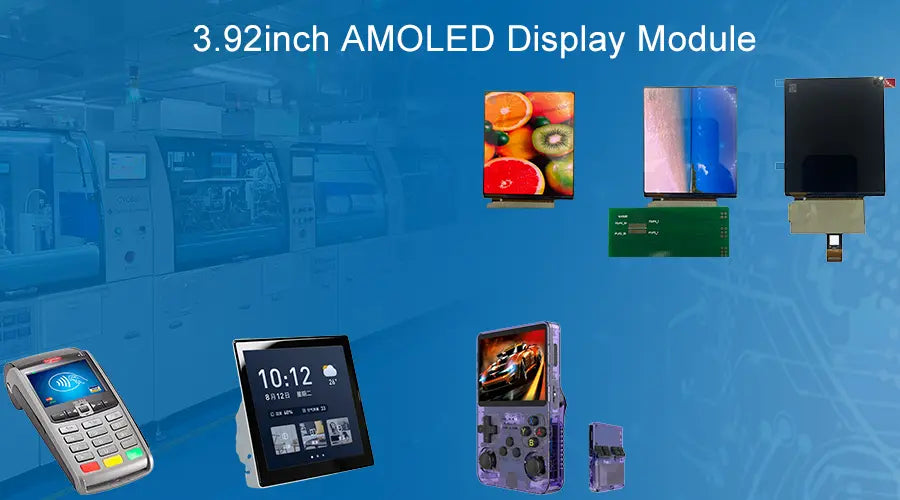
AMOLED, or Active-Matrix OLED, uses a TFT backplane with dedicated pixel-driving transistors. This architecture supports high resolution, larger display sizes, fast refresh rates, and precise pixel control. AMOLED is the dominant OLED architecture in smartphones, tablets, and many premium display products.
PMOLED
PMOLED, or Passive-Matrix OLED, uses a simpler row-and-column addressing method. It is suitable for smaller displays with simpler content and lower resolution requirements, such as status panels and compact interface modules.
Flexible and Foldable OLED Displays
Flexible OLED displays use polymer-based substrates and thin encapsulation systems that allow bending or folding. These displays require careful mechanical design, especially in relation to bend radius, hinge geometry, stress concentration, and moisture protection.
MicroOLED Displays
MicroOLED displays are ultra-high pixel density displays intended for near-eye systems such as AR and VR optics. These displays prioritize dense pixel packing, low latency, and high image sharpness in compact optical assemblies.
Materials, Deposition and Manufacturing
Emissive Materials
OLED performance is strongly influenced by emissive material selection. Fluorescent, phosphorescent, and advanced thermally activated systems each have different trade-offs in efficiency, color quality, and lifetime. Blue remains one of the most technically challenging emitter colors in terms of long-term stability.
Deposition Methods
Vacuum thermal evaporation remains a key manufacturing process for many OLED displays, especially where high-precision patterning is required. Printing-based approaches are also being developed for cost and scalability advantages, though they require strong process control to maintain film uniformity and yield.
Encapsulation and Barrier Technologies
OLED materials are highly sensitive to oxygen and moisture, so encapsulation quality is essential. Rigid displays often use glass-based protection, while flexible products use thin-film encapsulation systems that combine barrier performance with bendability.

Backplane Options
Backplane choice affects performance, power behavior, and achievable resolution. LTPS supports high mobility and dense pixel layouts, IGZO can offer lower leakage for larger formats, and LTPO enables dynamic refresh-rate control for power optimization in mobile systems.
Driving, Control and Calibration
Analog Current Drive vs PWM
OLED pixels are generally current-driven. Analog drive can help preserve color consistency across brightness levels, while PWM may be used for dimming in certain operating ranges. Modern systems often combine both methods to balance low-brightness control, flicker performance, and color stability.
Gamma, Color Profiles and Compensation
Maintaining OLED image quality over time requires factory calibration, white-point control, gamma mapping, and compensation algorithms that account for differential aging. Good system firmware can improve long-term visual consistency and reduce visible drift.
High Refresh and Variable Refresh Rate
OLED displays support high refresh operation and can be paired with variable refresh technologies to reduce power consumption in static scenes while maintaining fluid interaction during animation, gaming, or video playback.
Key Performance Metrics
Luminance, HDR Capability and Color Gamut
Evaluation should consider peak brightness, sustained brightness, color gamut coverage, and HDR behavior. In real use, both brightness capability and tone mapping behavior influence perceived image quality.
Contrast Ratio, Black Level and Viewing Angle
Because OLED pixels can be switched off individually, black level performance is one of OLED’s major strengths. Viewing angle behavior is also typically strong compared with many other display architectures.
Lifetime Metrics and Color Shift
Suppliers may express lifetime using metrics such as LT95 or LT50, describing brightness decline relative to initial luminance under specific operating conditions. Color stability over time is equally important and should be reviewed in relation to application demands.
Power Consumption
OLED power is content-dependent. Dark interfaces can reduce average power significantly, while bright high-average-picture-level use cases increase both power draw and thermal load.
Reliability and Failure Modes
Mechanism of Burn-In and Image Retention
Burn-in is caused by non-uniform aging across pixels or subpixels, often driven by persistent static content. It becomes visible when previously stressed image regions age faster than surrounding areas.
Mitigation Techniques
Mitigation can be addressed through UI design, firmware strategies such as pixel shifting and compensation, and material improvements that reduce long-term degradation. In products with highly static interfaces, mitigation planning should begin early in the design process.
Environmental Durability
OLED panels must be protected from moisture, oxygen, excess heat, and mechanical stress. Flexible panels require additional bend endurance validation and structural protection around fold or curve regions.

Testing and Quality Assurance
Photometric and Colorimetric Measurements
OLED testing often includes luminance uniformity, color uniformity, spectral behavior, and chromaticity analysis. These measurements help determine whether the panel meets image-quality and consistency requirements.
Environmental and Mechanical Stress Testing
Qualification may include thermal cycling, humidity exposure, vibration, shock, and bend endurance depending on product category. These tests are essential for validating long-term reliability.
Accelerated Aging and Burn-In Protocols
Accelerated testing at elevated brightness and temperature can be used to estimate long-term luminance decay and image-retention tendencies. This helps verify both panel robustness and compensation strategy effectiveness.
Electrical Safety and System Checks
Driver behavior, power delivery integrity, EMI performance, and connector robustness should all be verified during system integration to reduce field failure risk.
Design and Integration Guidance
UI and UX Guidelines
Dark themes, reduced static bright elements, adaptive brightness, and subtle movement of persistent UI features can help protect OLED lifetime while preserving user experience.
Mechanical Design and Thermal Management
Enclosures should prevent thermal hotspots and respect structural limits, especially in flexible implementations. Good heat spreading and careful driver placement contribute to stable long-term operation.
Electrical Interface and Connector Robustness
Use appropriate high-speed interfaces and ensure adequate ESD and EMI protection. Connector retention and shielding should be considered early in hardware design.
Firmware Strategies for Longevity
Firmware can support wear leveling, dynamic color compensation, and field-adjustable calibration. These features are useful in applications with long service life expectations.
Procurement Checklist
When sourcing OLED modules for production, define the panel architecture, substrate type, encapsulation strategy, native resolution, brightness targets, color requirements, lifetime expectations, power limits, mechanical dimensions, and qualification criteria.
Also review supply-chain details such as minimum order quantity, lead time, documentation quality, compliance support, and sample validation readiness.
Applications for OLED Displays
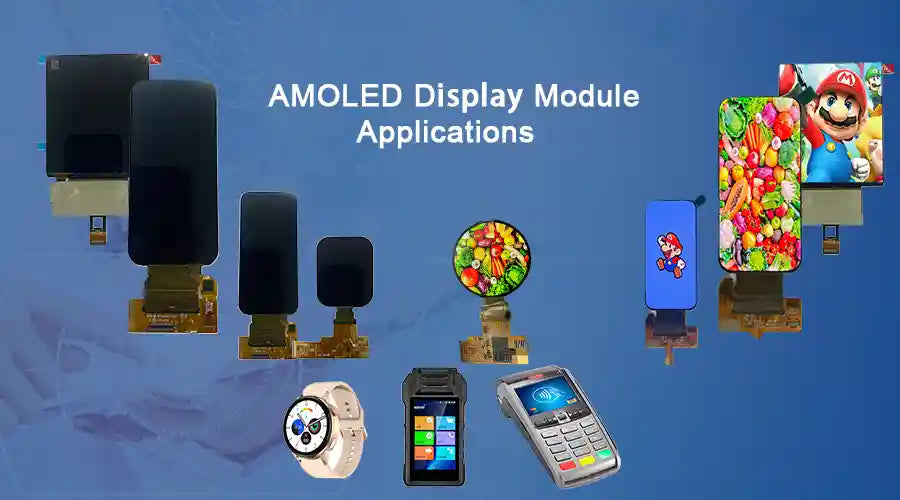
Smartphones and Tablets
OLED is widely used in flagship mobile devices because of its contrast, thin structure, fast response, and support for premium features such as always-on display and high refresh operation.
Wearables and Smartwatches
Small wearable interfaces benefit from OLED’s strong contrast and dark-mode efficiency. PMOLED and compact AMOLED architectures are both used depending on application needs.
Televisions and Professional Monitors
OLED televisions and reference-class monitors are valued for cinematic black levels, strong motion performance, and premium visual presentation.
Automotive Displays and HUD Systems
OLED can support curved interior integration, strong contrast, and premium cockpit design. Automotive applications require especially careful attention to temperature and long-term reliability.
AR and VR Near-Eye Systems
MicroOLED has become an important candidate for near-eye optics because of its high pixel density and low-latency image behavior.

Future Trends
Tandem OLED and High Peak Brightness
Tandem architectures continue to expand in importance where high brightness and longer lifetime are required together.
QD-OLED and Color Conversion
Color-conversion approaches using quantum-dot systems can improve spectral performance and create new options for efficiency and color purity.
MicroOLED and AR or VR Integration
MicroOLED development remains tightly linked to the evolution of next-generation near-eye optics and compact display engines.
Improved Blue Emitters and Advanced Materials
Progress in blue-emitter stability remains one of the most important material challenges for improving OLED lifetime and color consistency.
Conclusion
OLED displays provide excellent contrast, color performance, and design flexibility. Successful adoption depends on treating the display as part of a complete system that includes UI design, thermal control, firmware compensation, mechanical protection, and disciplined supplier validation.
FAQ
What is an OLED display and how does it differ from LCD?
OLED is self-emissive, meaning each pixel produces light directly. LCD requires a backlight. This gives OLED stronger black levels, higher contrast, thinner construction, and more design flexibility.
How can I reduce the risk of burn-in on an OLED display?
Use dark themes, avoid static bright elements, reduce unnecessary peak brightness, and implement firmware features such as pixel shifting and compensation.
Which OLED type should I choose for a smartphone versus an AR headset?
Smartphones typically use AMOLED because of its high resolution and active-matrix control. AR headsets often benefit from microOLED because of its extremely high pixel density and suitability for near-eye optics.

Hinterlasse einen Kommentar
Diese Website ist durch hCaptcha geschützt und es gelten die allgemeinen Geschäftsbedingungen und Datenschutzbestimmungen von hCaptcha.