
TFT Display Technology Explained
A technical guide to TFT display technology covering panel architecture, working principles, manufacturing flow, performance metrics, engineering challenges, and future development directions.
Introduction
Thin Film Transistor, or TFT, technology is one of the core foundations of modern display systems. It is widely used in active matrix LCD products across smartphones, tablets, industrial equipment, monitors, medical devices, and large-format display applications. TFT combines semiconductor switching structures with optical modulation layers to support precise pixel control, higher resolution, and improved image quality.
Historical Development
TFT-LCD technology has evolved over multiple decades, with each period bringing major improvements in resolution, manufacturing scale, material quality, and performance optimization.
- 1980s and 1990s: early commercial TFT-LCD development and lower-resolution panels
- 2000s: broader adoption of Full HD and larger consumer panels
- 2010s: expansion into 4K and advanced mobile displays
- 2020s: higher-resolution systems, quantum-dot enhancement, and more advanced backplane materials
Panel Structure
A TFT-LCD panel contains multiple interdependent layers and components that work together to switch, modulate, filter, and transmit light. These structures must be manufactured with tight dimensional and electrical control to ensure image uniformity and stable performance.
| Component | Function | Technical Description |
|---|---|---|
| Glass Substrate | Mechanical base | Provides structural support for TFT and optical layers |
| Gate Line | Row addressing | Selects pixel rows during scanning operation |
| Gate Insulator | Electrical isolation | Separates conductive layers in the TFT structure |
| Active Layer | Channel formation | Controls current flow in the transistor |
| Source and Drain | Electrical contact | Provide charge transport into and out of the TFT channel |
| Passivation Layer | Protection | Protects sensitive device layers from contamination and damage |
| Pixel Electrode | Pixel driving | Applies voltage to the liquid crystal cell |
| Alignment Layer | LC orientation | Controls initial liquid crystal molecular alignment |
| Spacers | Cell-gap control | Maintain consistent distance between panel substrates |
| Color Filter | Color generation | Produces red, green, and blue subpixel filtering |
| Common Electrode | Reference potential | Forms the driving field across the liquid crystal layer |
| Backlight Unit | Light source | Provides illumination for the LCD optical stack |
Cross-Sectional View

Figure 1: Cross-sectional structure of a TFT-LCD display stack.
Working Principles
Liquid Crystal Modulation Mechanism
The basic optical principle of TFT-LCD operation relies on how liquid crystal molecules change their orientation in response to an electric field. This changes polarization behavior and controls how much light passes through the panel.
Voltage-controlled birefringence calculation
Δn = nₑ - nₒ
Phase shift φ = (2π/λ) × Δn × d

Where:
nₑ = extraordinary refractive index
nₒ = ordinary refractive index
λ = wavelength of light
d = cell gap
Thin Film Transistor Physics
Each TFT acts as an electronic switch for an individual pixel or subpixel. During addressing, the gate line activates the transistor, allowing charge to flow and set the voltage at the pixel electrode.
- Linear region: the TFT behaves approximately like a controlled resistor
- Saturation region: the current becomes more weakly dependent on drain voltage
- Cutoff region: the transistor is effectively off
The drain current can be expressed as follows:
I_DS = μC_ox(W/L)[(V_GS - V_TH)V_DS - V_DS²/2]

Where:
μ = carrier mobility
C_ox = gate oxide capacitance
W/L = channel width-to-length ratio
Color Generation System
TFT-LCD panels generate color through a red, green, and blue filter structure placed over subpixels. The spectral properties of these color filters influence gamut, brightness, and color accuracy.
| Color | Peak Wavelength | Bandwidth | Transmittance |
|---|---|---|---|
| Red | 610 to 630 nm | Typical narrow-band range | Moderate |
| Green | 530 to 550 nm | Typical medium-band range | Higher than red and blue in many panels |
| Blue | 450 to 470 nm | Typical narrow-band range | Moderate |
Manufacturing Process
Array Process
The TFT array process includes multiple deposition, patterning, and etching steps used to form the transistor backplane. These steps require tight control over film thickness, geometry, defect density, and alignment.
- Deposition: forming functional material layers through PECVD, sputtering, or related methods
- Photolithography: transferring fine patterns through mask-based exposure
- Etching: removing selected regions to form conductors and device structures
- Post-treatment: annealing and passivation to improve stability and electrical characteristics
Cell Assembly
Cell assembly joins the TFT substrate with the color filter substrate while maintaining strict control of the liquid crystal gap and alignment conditions. Small variations can affect contrast, brightness uniformity, and viewing-angle behavior.
- Cell-gap control through spacers
- Vacuum-assisted liquid crystal filling
- Sealing with low-outgassing materials
- Precise alignment treatment for molecular orientation
Module Integration
In the module stage, the panel is combined with driver ICs, flexible circuits, backlight assemblies, and mechanical support parts. Bonding quality and electrical interconnection reliability are critical at this stage.
Driver IC bonding example
COG process parameters may include:
- anisotropic conductive film control
- temperature-controlled bonding
- pressure optimization
- process-time stability
Performance Metrics
Key Technical Specifications
| Metric | Standard Level | Advanced Level | High-End Level |
|---|---|---|---|
| Resolution | HD | FHD | 8K-class |
| Contrast Ratio | Moderate | Higher with panel optimization | Very high with local dimming support |
| Response Time | Slower standard LCD response | Improved with driving optimization | Fast with overdrive support |
| Color Gamut | sRGB-class | Wider gamut support | Near premium wide-color performance |
| Power Consumption | Higher in older systems | Reduced through efficiency improvements | Further reduced through advanced architecture |
Advanced Optimization Techniques
- Multi-domain design: improves viewing-angle characteristics
- Overdrive driving: reduces apparent response lag
- Local dimming backlights: improves effective contrast
- Compensation films: helps correct optical artifacts and off-axis degradation
Technical Challenges
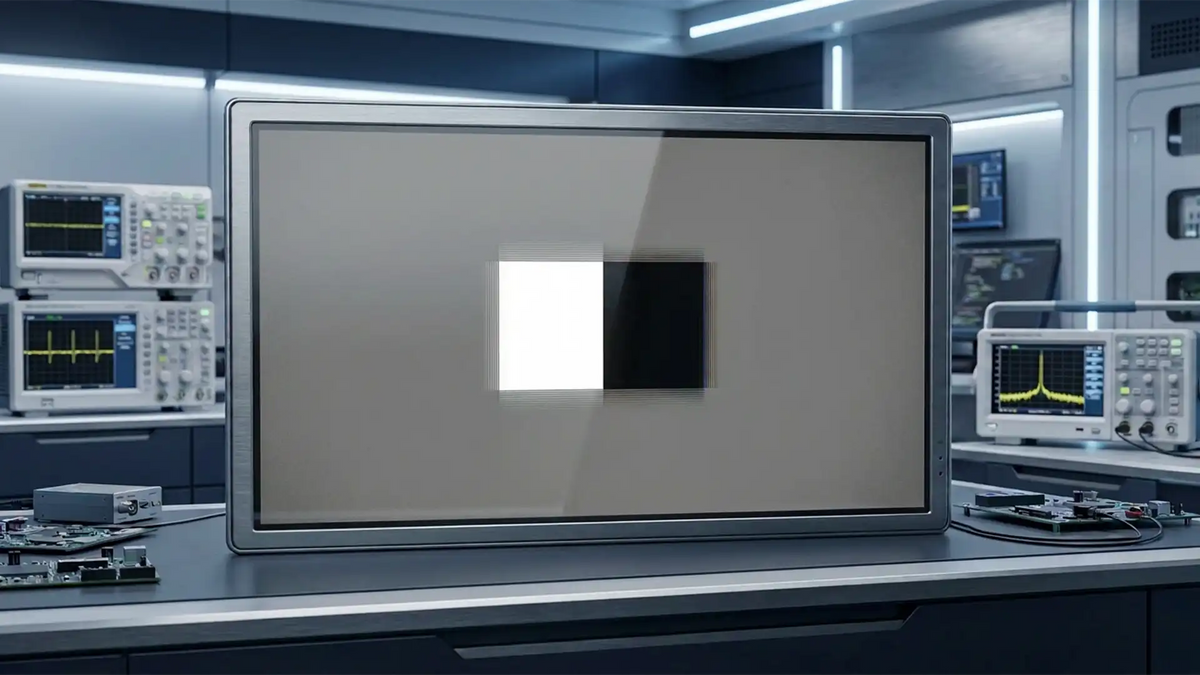
Image Sticking Prevention
TFT-LCD systems can experience image sticking due to residual charge, DC imbalance, or material-related effects. Prevention requires coordinated electrical, material, and driving-method optimization.
| Cause | Mitigation Strategy |
|---|---|
| DC voltage imbalance | Polarity inversion methods |
| Residual charge effects | Storage capacitor and driving optimization |
| Material or environmental degradation | Improved passivation and process control |
Power Consumption Reduction
Power in TFT-LCD systems is mainly distributed across the liquid crystal drive, driver electronics, and backlight unit. A significant portion often comes from the backlight, so optical efficiency improvement is a major engineering target.
Power model
P_total = P_LC + P_driver + P_backlight

Optimization directions:
1. Improve backlight efficiency
2. Reduce driver voltage where possible
3. Increase pixel aperture ratio
4. Improve optical transmission efficiency
Future Trends
Material Innovations
- IGZO: higher carrier mobility than conventional amorphous silicon
- LTPS: very high mobility for advanced backplane applications
- New transparent conductors: alternatives to ITO for performance and flexibility goals
Manufacturing Advancements
| Technology | Advantages | Challenges |
|---|---|---|
| Advanced lithography | Smaller feature size and tighter control | High equipment cost |
| Roll-to-roll processing | Potential cost reduction in suitable applications | Material and process stability |
| AI-assisted process control | Yield and consistency improvement | Complex data integration requirements |
Emerging Applications
- Automotive head-up displays with very high brightness
- Medical displays with specialized grayscale requirements
- Flexible display implementations
- Transparent display concepts for commercial and industrial use


Hinterlasse einen Kommentar
Diese Website ist durch hCaptcha geschützt und es gelten die allgemeinen Geschäftsbedingungen und Datenschutzbestimmungen von hCaptcha.