
Engineering Guide
A structured technical overview for product designers, engineers, and procurement teams
1. What Is an OLED Display and Why It Matters
OLED (Organic Light-Emitting Diode) displays are self-emissive, meaning each pixel generates its own light. Unlike LCDs that require a backlight, OLED pixels produce light through electroluminescence in organic compounds, enabling high contrast and advanced industrial design flexibility.
Self-Emissive vs Backlit LCD
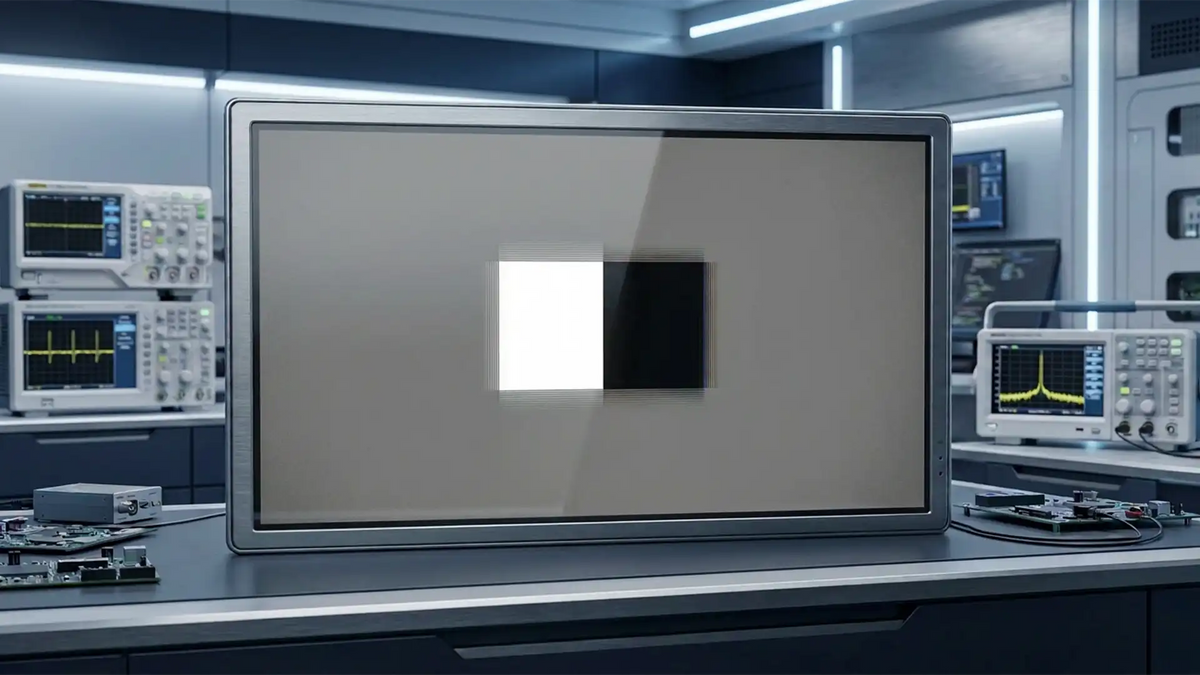
LCDs control light transmission from a separate backlight through liquid crystal layers, while OLED pixels act as individual light sources. This allows true black reproduction, faster response time, and thinner module construction because no backlight unit is required.
Key Advantages
- Very high contrast and deep black performance
- Flexible, curved, and transparent design possibilities
- Wide viewing angle with limited color shift
- Fast response suitable for advanced visual systems
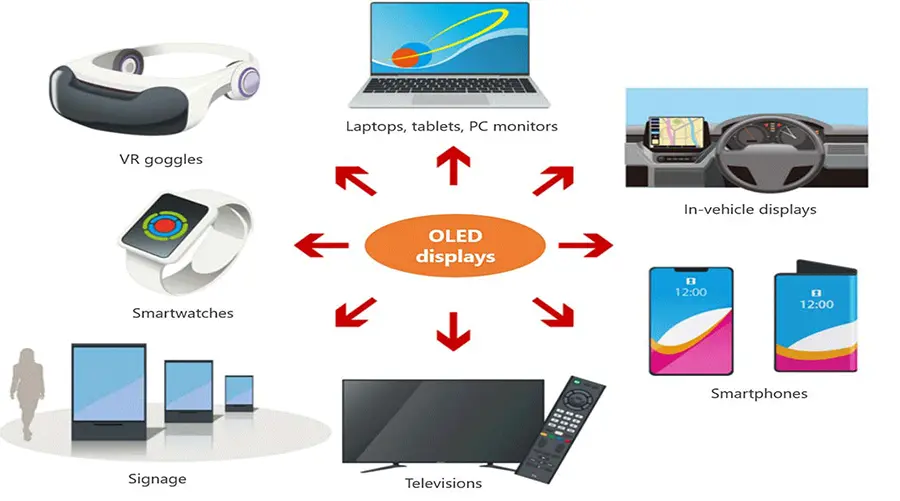
OLED adoption has expanded from smartphones into televisions, wearables, automotive displays, and emerging near-eye systems.

2. OLED Science: How Light Is Generated
OLED emission comes from carrier recombination inside organic thin-film layers. When voltage is applied, electrons and holes are injected from opposite electrodes and combine to form excitons, which release visible light when they decay radiatively.
Pixel Structure and Exciton Recombination
A typical OLED stack includes a transparent anode, hole transport layer, emissive layer, electron transport layer, and cathode. Energy-level alignment across these layers is critical for luminous efficiency and stable panel performance.
RGB vs WRGB
RGB OLED uses separate red, green, and blue subpixels. WRGB adds a white subpixel and color filtering strategy, which is commonly used in large-area display implementations to support brightness and lifetime optimization.
Singlet vs Triplet Excitons
Fluorescent emitters mainly harvest singlet excitons, while phosphorescent and TADF systems can utilize triplet excitons more effectively. This is important for improving internal quantum efficiency and advancing future emitter performance.

3. Core OLED Materials and Structure
| Emitter | Description | Efficiency | Remarks |
|---|---|---|---|
| Fluorescent | Organic emitter system | Lower | Cost-effective but limited in efficiency |
| Phosphorescent | Metal-complex doped system | High | High efficiency with material cost considerations |
| TADF | Thermally activated delayed fluorescence | Very high potential | Important pathway for future blue emitter development |
Transparent Electrodes
To support flexible structures, alternatives to brittle ITO are being developed, including graphene, silver nanowire, and metal mesh approaches that aim to balance conductivity, transparency, and bending durability.
The Blue-Emitter Bottleneck
Blue emission is one of the most challenging areas in OLED engineering because higher-energy photons accelerate material degradation. Blue-emitter progress remains central to panel lifetime improvement and broader OLED adoption.

4. OLED Manufacturing Technology
OLED fabrication combines precision patterning, thin-film deposition, contamination control, backplane integration, and encapsulation processes.
Vacuum Evaporation and Fine Metal Mask
This is the dominant approach for high-resolution small and mid-size OLED panels. Fine metal masks define subpixel deposition areas, although scalability and mask management remain engineering challenges.
Inkjet Printing
Inkjet printing is an additive process that reduces material waste and supports development toward larger substrate formats. It is especially attractive for cost optimization in larger OLED panels.
Backplane Technologies
LTPS supports high drive performance for high pixel density applications, while IGZO and oxide TFT approaches are valued for lower leakage and large-area suitability. Backplane choice directly affects power, resolution, and cost.
Encapsulation
Because OLED materials are sensitive to moisture and oxygen, encapsulation is essential. Rigid glass sealing and thin-film encapsulation are both used depending on whether the product is rigid or flexible.

5. OLED Display Performance Metrics
- High peak brightness in advanced panel designs
- Very high contrast because black pixels can be fully off
- Wide color capability in premium implementations
- Fast response for motion-critical applications
- Lifetime depends strongly on brightness, content pattern, and emitter system
Burn-in Mitigation
Burn-in risk can be reduced using compensation algorithms, pixel refresh cycles, UI movement strategies, logo dimming, and brightness control.
Power vs APL
OLED power consumption is influenced by average picture level. Darker interfaces are generally more power-efficient than bright interfaces, which is important in battery-powered product design.

6. Types of OLED Displays
| Type | Application | Key Point |
|---|---|---|
| PMOLED | Simple modules and compact devices | Lower cost and lower resolution |
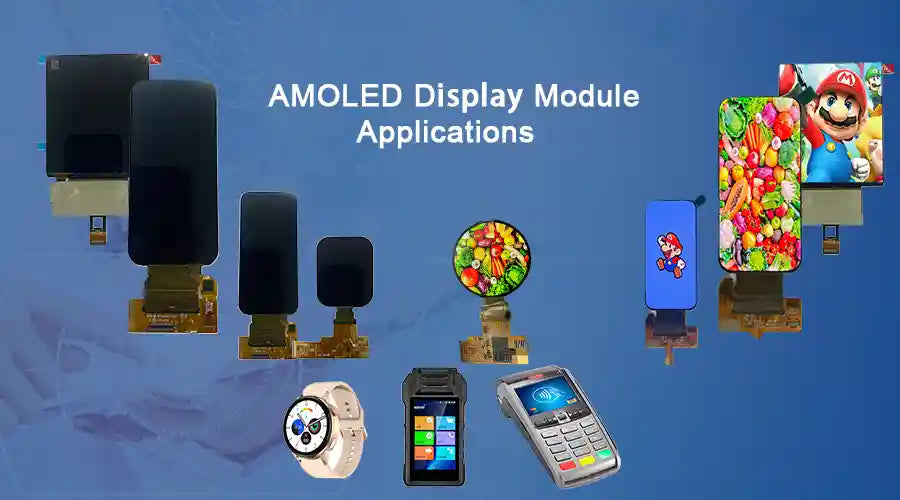
| AMOLED | Phones, tablets, laptops, automotive | Mainstream active-matrix solution |
| Flexible OLED | Wearables and curved products | Supports bending and advanced industrial design |
| Foldable and Rollable | Novel product categories | Designed for repeated mechanical deformation |
| Transparent OLED | HUD and retail display applications | Combines display and see-through functionality |
| MicroOLED | AR and VR optical systems | Very high pixel density on silicon backplane |

7. OLED Application Fields
- Consumer electronics: smartphones, tablets, wearables, and premium notebooks
- Automotive: curved dashboards, center information displays, and advanced HMI concepts
- Medical devices: specialized interfaces where contrast and compact integration are valuable
- Wearables: low-power dark UI and compact mechanical packaging
- AR and VR microdisplays: high pixel density and low-latency response

8. OLED vs Competing Technologies
| Metric | OLED | Mini-LED LCD | MicroLED |
|---|---|---|---|
| Contrast | Very strong | Strong | Very strong |
| Brightness | Strong | Very strong | Very strong |
| Flexibility | Very strong | Limited | Strong potential |
| Cost maturity | Mid-level | High | Lower maturity |
OLED currently offers a practical balance of contrast, form-factor flexibility, supply maturity, and premium image quality, while Mini-LED LCD and MicroLED address different performance and cost priorities.
9. Engineering Challenges and Solutions
- Brightness: tandem OLED structures and optical extraction improvements can increase luminance efficiency
- Burn-in: aging compensation algorithms and firmware strategies help reduce visible non-uniformity
- Blue lifetime: new emitter systems continue to target longer operational stability
- Cost reduction: process improvement and larger substrate strategies aim to improve manufacturing economics

10. Future Outlook
Future OLED development is focused on higher brightness, better power efficiency, longer blue lifetime, improved flexible durability, automotive-grade reliability, and scalable manufacturing. QD-OLED, tandem OLED, and MicroOLED remain key directions in premium display innovation.
Sustainability is also becoming more important, with increasing attention on lower material waste, more efficient processing, and improved lifecycle value in commercial deployment.
11. Frequently Asked Questions
How can OLED burn-in be reduced?
Common methods include pixel refresh, UI shifting, logo dimming, brightness management, and compensation mapping based on panel aging behavior.
What lifetime can be expected from industrial OLED panels?
Actual lifetime depends on brightness level, temperature, content pattern, and panel design. Evaluation should be based on the specific use case rather than a single generic lifetime value.
Is touch compatible with OLED modules?
Yes. OLED modules can integrate touch through on-cell, in-cell, or add-on structures depending on product design, thickness target, and cost requirements.
How does OLED compare with MicroLED in long-term development?
MicroLED has long-term potential in brightness and durability, but OLED currently holds stronger maturity in mass production, flexible design, and practical deployment across many premium categories.
12. Conclusion and YouTube Demo
OLED technology combines self-emissive image quality, thin structure, design flexibility, and fast response. It is especially valuable in products where visual impact, compact integration, and premium interaction experience are important selection criteria.

Hinterlasse einen Kommentar
Diese Website ist durch hCaptcha geschützt und es gelten die allgemeinen Geschäftsbedingungen und Datenschutzbestimmungen von hCaptcha.