
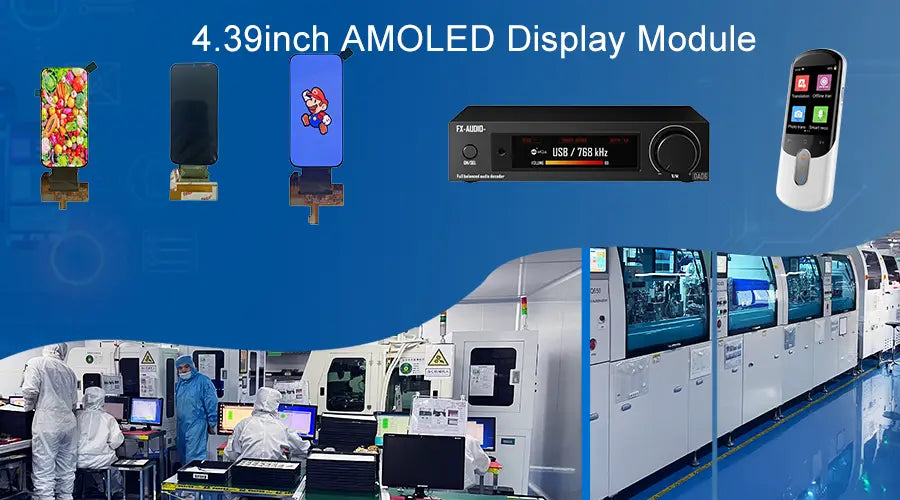
OLED Display (0.96–8 inch)
A practical guide to OLED display selection for wearables, IoT, automotive, industrial, medical, and smart home products.
OLED Display Overview and Core Advantages
Organic Light-Emitting Diode, or OLED, is a self-emissive display technology. Each pixel generates its own light when driven electrically, so the display does not need a separate backlight. That is one of the main reasons OLED panels are known for deep black levels, strong contrast, fast response, and thin module construction.
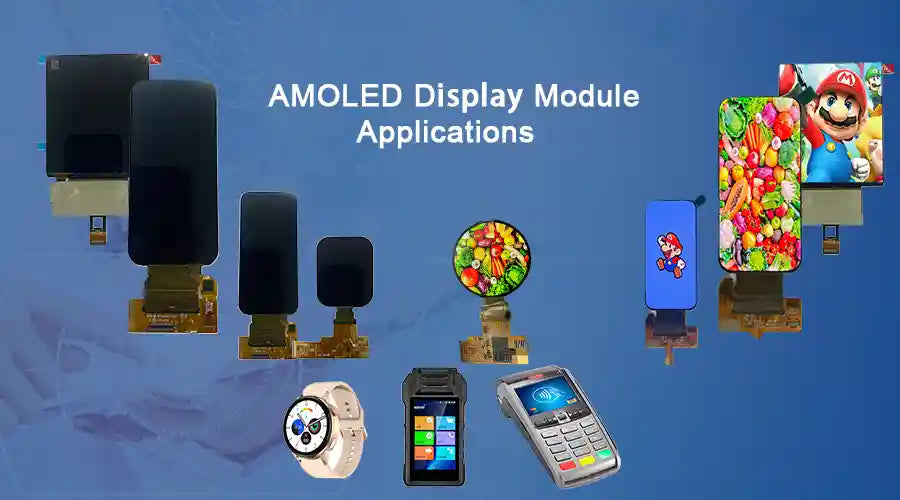
In embedded systems and consumer electronics, OLED is widely used where image quality, compact structure, and viewing performance matter. It is common in smartwatches, compact instruments, automotive interfaces, medical devices, industrial HMIs, and portable electronics.
Key advantages of OLED technology include:
- High contrast: Pixels can switch off completely, producing true black.
- Wide viewing angles: Image quality remains stable across broad viewing positions.
- Fast response time: Motion blur is reduced compared with slower display structures.
- Thin and lightweight design: No backlight layer is required.
- Better dark-scene power behavior: Black pixels use little or no power.
- Strong color performance: OLED can produce vivid and visually rich images.
OLED also has practical limitations. It is sensitive to moisture and oxygen, and long-term static content can cause uneven aging. Because of that, encapsulation quality and UI design are both important for product life.

0.96–1.3 inch OLED: Ideal for Wearables and IoT Devices
Displays in this size range are commonly used in fitness trackers, compact sensors, smart wearables, and small IoT products. Typical resolutions include 128×64, 128×128, and similar compact formats. These modules are often chosen because they are efficient, easy to integrate, and visually clear in small interfaces.
Small OLED modules are usually paired with low-power microcontrollers such as ESP32, STM32, or nRF series devices. Common interfaces are I2C and SPI. Monochrome variants are still popular in this range because they are simple, efficient, and practical for compact devices with limited power budgets.
Design Tips
- Use dark backgrounds: This helps reduce power draw and can improve lifetime behavior.
- Avoid static content: Screen timeout, movement, or pixel shifting can reduce uneven aging.
- Optimize refresh behavior: Updating only what changes can save energy.
- Choose PMOLED where appropriate: For very small and simple interfaces, it can still be a practical option.

1.5–2.8 inch OLED: For Portable and Handheld Devices
This size range is widely used in handheld meters, portable medical products, compact terminals, and small consumer devices. Compared with smaller OLED modules, these displays can support richer interfaces, more icons, and more readable graphics.
Modules in this range often use SPI for faster communication and smoother UI updates. Depending on the product, some also support partial refresh and low-power operating modes that help battery-powered systems.
Applications
- Portable ECG monitors
- Audio recorders
- Barcode scanners
- Handheld test equipment
- POS terminals

3–5 inch OLED: Automotive and Advanced HMIs
OLED displays in this range are increasingly used in automotive clusters, infotainment-related systems, and more advanced HMI designs. At this size, the display often needs to support sharper graphics, multi-region layouts, and more demanding visual performance.
These panels commonly use MIPI DSI and are usually paired with more capable processors or SoCs. In automotive and high-performance embedded systems, brightness, operating temperature, and surface treatment become more important than in smaller portable products.
Key Features
- Higher brightness and anti-reflective surface options
- Wider operating temperature support
- Touch overlay compatibility
- Enhanced reliability requirements for demanding environments
- Support for more advanced UI systems

5–8 inch OLED: Industrial, Medical, and Professional Displays
Larger OLED modules are used in products such as medical display systems, industrial control interfaces, and specialized professional equipment. At this size, image quality, interface bandwidth, EMC design, and thermal conditions all become more important in the system design process.
These displays may use MIPI DSI or LVDS depending on the platform. In harsher operating environments, additional measures such as shielding, optical bonding, and front-surface protection may be required.
Use Cases
- Medical ultrasound and endoscopy-related displays
- Industrial PLC HMIs
- Military and aerospace equipment
- Professional video monitoring
- Smart home control panels

Interface Comparison: I2C vs SPI vs MIPI DSI
Choosing the interface affects data speed, pin count, processor compatibility, and system complexity. In practice, the correct interface depends mainly on resolution, refresh requirement, and controller capability.
| Interface | Speed | Pin Count | Use Case |
|---|---|---|---|
| I2C | Low | 2 signal lines | Static interfaces and small monochrome OLEDs |
| SPI | Medium | Usually 4–6 pins | Small color OLEDs and medium-resolution animated UIs |
| MIPI DSI | High | Multiple differential lanes | High-resolution color displays in automotive and industrial systems |
Key Specifications by Size Range
| Size (inch) | Typical Resolution | Interface | Brightness (nits) | Power (typ.) |
|---|---|---|---|---|
| 0.96–1.3 | 128×64, 128×128 | I2C / SPI | 100–200 | 0.05–0.2W |
| 1.5–2.8 | 240×240, 240×320 | SPI | 200–400 | 0.3–0.8W |
| 3–5 | 480×800, 720×1280 | MIPI DSI | 500–1000 | 1.5–3W |
| 5–8 | 1080×1920, 1200×1920 | MIPI DSI / LVDS | 400–800 | 3–6W |

Frequently Asked Questions
Can OLED displays be used in sunlight?
Yes, depending on brightness level, front-surface treatment, and application environment. Larger automotive and industrial OLED modules are more likely to include the brightness and coating options needed for stronger ambient-light performance.
How can OLED burn-in be reduced?
Using dark themes, limiting static content, applying screen timeout, and enabling pixel shift or logo dimming can all help reduce uneven aging.
Are OLEDs suitable for medical devices?
They can be, especially where contrast and image quality matter. The final decision should also consider compliance requirements, operating conditions, and the exact device category.
What is the typical lifespan of an OLED?
Lifetime varies by brightness, content pattern, materials, and operating conditions. It is better to review supplier lifetime data under conditions similar to the real application rather than rely on a single generic number.
Next Steps: Browse and Order OLED Displays
Explore the full range of OLED Display (0.96–8 inch) options for your project. You can compare by size, interface, resolution, and touch capability.
If you need help selecting the right module, contact the engineering team for technical discussion and product matching.

Hinterlasse einen Kommentar
Diese Website ist durch hCaptcha geschützt und es gelten die allgemeinen Geschäftsbedingungen und Datenschutzbestimmungen von hCaptcha.