

Executive Summary
This article looks at AMOLED technology with a focus on modules from 1.38 inches to 8.0 inches. It covers the basic structure, drive method, practical performance metrics, common integration concerns, and the kinds of applications where these modules are typically used. Brownopto offers customizable AMOLED modules across this size range for wearables, automotive systems, industrial HMIs, and other specialized equipment.
Note: This article is written for product teams, hardware engineers, and buyers evaluating AMOLED modules for integration. For product discussion, sampling, or customization support, see the Brownopto module links later in this page.
What is AMOLED?
AMOLED stands for Active Matrix Organic Light-Emitting Diode. It is a self-emissive display technology in which each pixel produces its own light. Unlike LCD structures that need a backlight, AMOLED panels generate light directly at the pixel level, which allows stronger contrast, thinner module construction, and better black performance.
Key structural components
- TFT backplane: Usually based on LTPS or oxide TFT technology, used to control each pixel accurately.
- Organic emissive stack: The light-emitting structure that determines color, efficiency, and lifetime behavior.
- Encapsulation and barrier: Protective layers that prevent moisture and oxygen from damaging the OLED materials.
- Driver ICs and flex connection: Interface and control components matched to the module design and system requirements.

How AMOLED Works
Each AMOLED pixel is made up of red, green, and blue sub-pixels that emit light when driven by current. The active-matrix structure uses TFTs to maintain pixel control during each frame, which supports better brightness stability, higher resolution, and smoother motion than simpler passive approaches.
Driving methods
Two broad drive concepts are commonly discussed:
- Passive or voltage-style addressing: More limited and not ideal for high-resolution panels.
- Current-driven active matrix: The standard approach for AMOLED, used for more precise brightness control and better image stability.
Color and calibration
AMOLED color performance depends on both the emissive materials and the way the panel is tuned. In practical applications, good results usually require factory calibration, target white-point control, and gamma adjustment during system integration.
Key Advantages
Superior contrast and black level
Because individual pixels can switch off completely, AMOLED can produce very deep black levels and strong perceived contrast. This is one of the main reasons it is used in premium consumer products and visual interfaces where image depth matters.
Thin profiles and flexibility
Without a backlight unit, AMOLED modules can be built with thinner stacks than conventional LCD solutions. In some designs, the technology also supports flexible form factors that are useful in wearables and specialized product shapes.
Faster response times
AMOLED displays typically respond very quickly, which helps reduce motion blur and improves the appearance of animation, video, and interactive UI elements.
Power efficiency for dark UIs
AMOLED generally performs well in interfaces with large dark areas because black pixels emit little or no light. This is why dark-mode interfaces can reduce power use compared with brighter screen content.
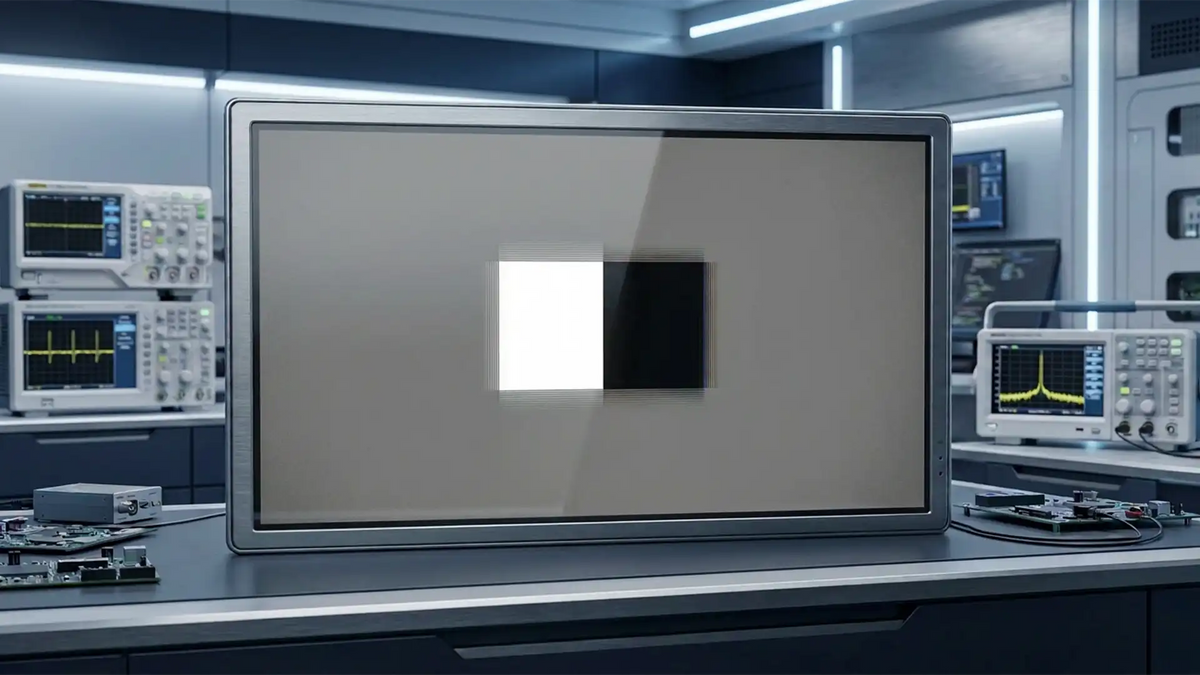
Performance Metrics and Measurement
When evaluating an AMOLED module, it is useful to measure actual engineering values rather than rely only on general descriptions. Common items include:
- Luminance: Peak and typical brightness under defined test conditions.
- Color coordinates: White-point and chromaticity measurement.
- Contrast ratio: Ratio between bright and dark output.
- Lifetime: Measured under specified brightness and operating conditions.
- Burn-in or image retention behavior: Especially important in static UI applications.
- Power consumption: Both average and worst-case current draw should be reviewed.
- Spectroradiometer for color and spectral measurement
- Integrating sphere for luminance and light output testing
- Environmental chamber for humidity, temperature, and lifetime-related testing
Form Factors: 1.38–8.0 inch Modules
Brownopto supports AMOLED modules across small and medium display sizes. Different size ranges usually align with different product categories and integration priorities.
| Diagonal | Typical Use Cases | Design Considerations |
|---|---|---|
| 1.38 inch – 2.0 inch | Wearables, compact sensors, portable devices | Low power, high pixel density, small connector routing |
| 2.4 inch – 3.5 inch | Handheld devices, remotes, compact control panels | Brightness balance, touch integration, mounting structure |
| 3.5 inch – 5.0 inch | Industrial HMI, medical handheld devices | EMC control, connector robustness, optical bonding |
| 5.5 inch – 8.0 inch | Automotive clusters, infotainment-related displays | Higher brightness, anti-reflective treatment, temperature resilience |
Depending on project needs, Brownopto can support customization in resolution, interface type, touch integration, and mechanical structure.

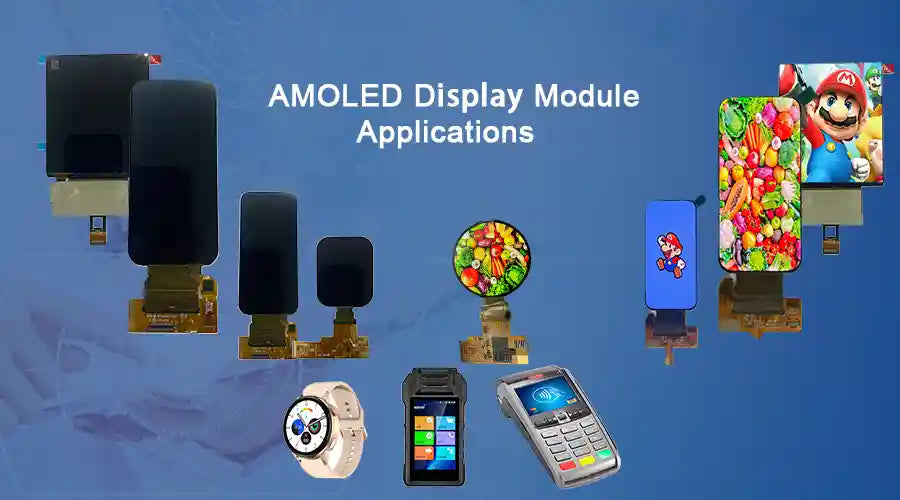
Primary Applications
Wearables and Health Devices
Small AMOLED modules are well suited to wearable products because they combine high contrast with compact structure. In health devices and compact electronics, readability and power behavior are often key advantages.
Industrial HMI
For industrial interfaces, AMOLED can provide strong contrast and good viewing performance in changing ambient light conditions. Mid-size modules are often selected for equipment that needs a more premium visual interface.
Automotive Interfaces
Automotive applications may require higher brightness, wider operating temperature, and improved surface treatment. In these systems, anti-reflective coatings and adaptive brightness control are often important.
Integration Guidelines for Engineers
Power and Thermal Management
Because AMOLED is current-driven, power design should account for peak current demand as well as average operating load. Thermal design also matters, since extended high-brightness operation can accelerate aging and affect long-term stability.
EMI and Signal Integrity
For high-speed interfaces such as MIPI DSI, routing quality, connector shielding, and ESD protection all need attention. Poor signal integrity can affect both performance and reliability.
Touch and Optical Bonding
Optical bonding can improve visibility by reducing internal reflection between layers. For products used in bright environments, the choice of adhesive and optical stack has a visible effect on display quality.
Firmware and Gamma Calibration
Firmware tuning can help maintain more consistent brightness and color behavior over time. In some projects, calibration data and reference profiles from the module supplier can shorten integration work.
Brownopto AMOLED Modules
Brownopto supplies customizable AMOLED modules covering diagonal sizes from 1.38 inch to 8.0 inch. Options typically include different resolutions, interface choices, and optional touch integration.
Explore AMOLED Modules Collection
Sample datasheet request
If you need sample units or a custom quote, it helps to provide the target diagonal, interface type, operating temperature range, mechanical requirements, and expected annual volume. That usually makes the matching process faster and more accurate.
Conclusion
AMOLED remains one of the most capable display technologies for products that need strong contrast, fast response, thin design, and flexible integration potential. For modules in the 1.38 inch to 8.0 inch range, the right choice depends on more than size alone. Brightness target, UI profile, power budget, thermal conditions, interface, and lifetime expectations all need to be reviewed together before final selection.


Hinterlasse einen Kommentar
Diese Website ist durch hCaptcha geschützt und es gelten die allgemeinen Geschäftsbedingungen und Datenschutzbestimmungen von hCaptcha.