
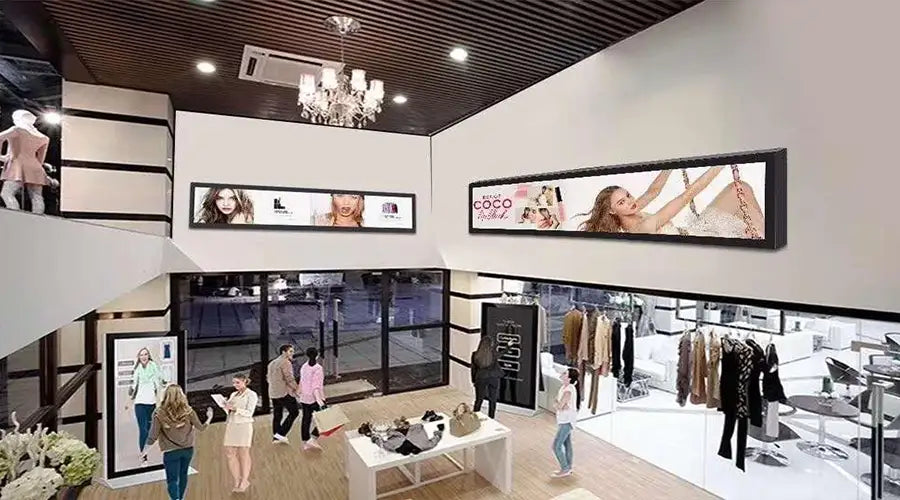
How ultra-wide displays, edge intelligence, and API-driven content are reshaping retail, transportation, smart buildings, and industrial HMI.
1. Executive Summary #
Stretched bar LCD displays are moving from a niche format toward broader mainstream adoption as retailers, transit operators, smart buildings, and industrial environments look for glanceable information in narrow physical spaces. Improvements in panel manufacturing, higher brightness capability, and durable industrial construction are combining with smarter embedded platforms and more flexible content workflows.
Over the coming deployment cycles, adoption is likely to be driven by API-oriented content systems, tighter links with POS, ERP, and inventory platforms, and clearer measurement of ROI through compliance improvements, media monetization, and lower operating friction.
2. Market Context #
- Retail digitization is increasing demand for faster and more flexible pricing updates.
- Transit and public infrastructure projects need clearer guidance in long, narrow physical zones.
- Many installation environments have limited space where full-size displays are impractical.
- Organizations increasingly want contextual information that complements larger screens instead of replacing them.
3. Technology Evolution #
Panels and Optics 8:1–16:1
- Advanced production methods support ultra-wide aspect ratios with better visual consistency.
- Higher brightness ranges improve usability in commercial daylight and bright interior settings.
- Anti-reflective treatment and high-temperature resilience improve field performance.
Efficiency and Ruggedization
- More efficient backlight design helps balance brightness and power use.
- Fanless thermal structures reduce maintenance needs in many applications.
- Protective front-surface options improve suitability for public and industrial installations.

4. Smart OS and Edge #
- Android and embedded Linux remain common due to their flexibility and ecosystem maturity.
- Modern ARM-based compute platforms can handle layout rendering, video playback, and lightweight local analytics.
- Sensor-linked workflows can trigger more contextual content while keeping some processing local to the device.
5. Content and CMS #
- Headless and API-oriented content systems make real-time information updates easier to automate.
- Dynamic pricing, scheduling, testing, and rule-based content control are becoming more common.
- Offline-first playback and fleet health visibility improve resilience at scale.
6. Form Factors #
- Single-bar, curved, and modular rail-style configurations support different architectural needs.
- Low-profile mounting and hidden cabling improve appearance and serviceability.
- Public-facing environments increasingly require more resistant front-surface design.
7. Connectivity #
- Wi-Fi and cellular-connected deployments support distributed fleets in retail and transport environments.
- Remote provisioning and mobile device management reduce installation complexity.
- Local caching helps maintain service continuity when networks are unstable.
8. Use Cases #
- Retail: Shelf-edge pricing, planogram support, and promotional messaging.
- Food service: Menu rails, queue communication, and operational messaging.
- Transit: Wayfinding, platform updates, and occupancy-related information.
- Smart buildings: Directories, parking guidance, and occupancy cues.
- Industrial: Narrow-space HMI layouts and process alerts.

9. ROI and Metrics #
- Basket size and attachment-rate uplift in retail settings.
- Faster update cycles and stronger pricing compliance.
- Media revenue efficiency per installation length or location.
- Service cost reduction through fewer maintenance interventions.
10. Challenges #
- Narrow chassis designs create thermal challenges at higher brightness levels.
- Glare and legibility must be managed carefully in bright environments.
- Panel availability and long-term continuity can affect supply stability.
- Lifecycle planning is essential for updates, spares, and end-of-life handling.
11. Standards #
- Electrical, EMC, and installation compliance requirements vary by region and application.
- Energy use and sustainability requirements are becoming more relevant in procurement.
- Accessible design principles such as contrast, legibility, and placement should be considered early.
12. Integration #
- Live links to POS, ERP, or inventory systems allow more accurate and responsive content.
- Sensor and camera integrations can support smarter decision logic at the edge.
- Privacy-aware design should include data minimization and local processing where appropriate.
13. Procurement Guide #
- Panel: Size, resolution, brightness, color behavior, and temperature resilience.
- Compute: SoC capability, memory, storage, codec support, and update roadmap.
- Compatibility: CMS support, protocol support, APIs, and warranty structure.
- Total cost: Energy, installation effort, accessories, and serviceability.
14. Emerging Trends #
- Mini-LED backlights for stronger brightness efficiency.
- AI-assisted layout adaptation and rule-based automation.
- Hybrid low-power display models for specialized use cases.
- More modular rail systems and sustainability-oriented deployment design.
15. Case Snapshots #
- Retail chain: Faster synchronized price updates across multiple locations.
- Transit hub: Better passenger guidance and more visible edge messaging.
- Food service: Promotional rail messaging tied to peak traffic periods.
- Office campus: Parking and navigation guidance in constrained spaces.
16. Implementation #
- Start with a pilot and define measurable KPIs.
- Complete a site survey for power, network, mounting, and environmental conditions.
- Prepare content templates and legibility rules for elongated display zones.
- Plan integration with operational systems and complete a security review.
- Train operations teams and define support workflows and SLAs.
17. Conclusion #
Stretched bar LCD displays create high-value communication surfaces in spaces where traditional display formats are inefficient. When combined with embedded intelligence, strong integration planning, and measurable performance objectives, they can support both operational efficiency and user-facing engagement.
Plan your pilot: request a demo, get a specification template, and validate KPIs through a controlled rollout.
Request a DemoFAQ #
What brightness do I need for retail aisles versus window-facing installs?
Typical retail aisle environments usually require less brightness than direct daylight or window-facing installations. The correct target should be based on real environmental lighting and readability testing at the site.
Android or Linux: what is better for long-term support?
Both can work well. The more important factor is the vendor’s software roadmap, patch policy, update consistency, and long-term maintenance commitment.
How do I calculate ROI for shelf-edge bars?
Start by measuring metrics such as sales uplift, pricing accuracy, update speed, labor savings, and any media revenue contribution. A controlled pilot across comparable locations helps establish a credible baseline.
Do I need cameras for analytics?
No. Many deployments can begin with operational system data, traffic counters, or other lower-complexity inputs before adding camera-based analytics.
What mounting and power options work best?
The best choice depends on the site. Low-profile mounting with clean cable routing is usually preferred, while power strategy should match service access, network architecture, and enclosure design.
Need specifications or an RFP checklist?
Get a vendor comparison worksheet and an integration planning template for your next project.
Get the Templates


Hinterlasse einen Kommentar
Diese Website ist durch hCaptcha geschützt und es gelten die allgemeinen Geschäftsbedingungen und Datenschutzbestimmungen von hCaptcha.