
Overview #
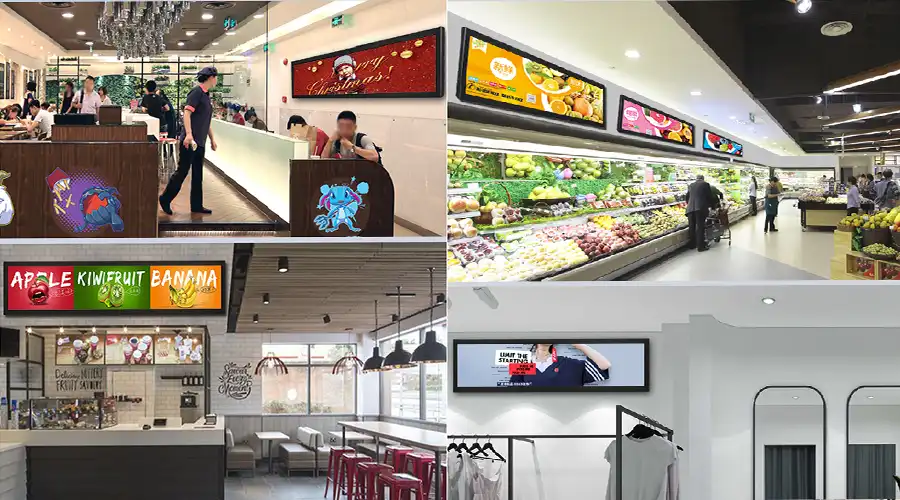
Stretched Bar LCD displays, also known as ultra-wide or bar-type LCDs, are increasingly used in retail signage, transportation systems, industrial equipment, and smart commercial environments. Unlike standard 16:9 displays, these products use non-traditional aspect ratios such as 16:3, 24:5, or even wider formats.
For many B2B projects, standard products are not enough. This is where custom stretched bar LCD displays become essential. Customization allows brands, system integrators, and OEM buyers to tailor size, performance, interface, and mechanical structure to specific project needs.

Why Choose a Custom Stretched Bar LCD Display #
While standard bar LCD sizes can work for general digital signage, many professional applications require precise mechanical fit, electrical compatibility, or environmental durability. Custom bar LCD displays help solve these challenges by offering:
- Better fit for unique installation spaces
- Optimized brightness and contrast for specific lighting conditions
- Smoother integration with existing hardware and software platforms
- More stable long-term supply for commercial and industrial deployment
For shelf-edge displays, transportation signage, and embedded equipment, customization is often a practical requirement rather than an optional feature.

What Can Be Customized in a Stretched Bar LCD #
1. Display Size and Aspect Ratio
Custom bar LCD displays can be developed in a wide range of diagonal sizes, commonly from 8.6 inch up to 86 inch, with non-standard aspect ratios adjusted to the target application.
- Exact diagonal size and active area
- Ultra-wide or low-height formats
- Special elongated or cut-panel structures
2. Resolution and Pixel Configuration
Resolution can be customized to balance image clarity, cost, and system bandwidth requirements. Common options include:
- Stretched high-definition resolutions such as 1920 × 360 or 3840 × 600
- Custom pixel mapping for advertising or data-display purposes
- Optimized PPI for close-range viewing or long-distance visibility
3. Brightness and Optical Performance
Brightness is one of the most important parameters in a bar LCD project. Typical customization options include:
- Standard indoor brightness levels around 300 to 500 nits
- High-brightness versions from 700 to 1500 nits for stronger ambient light
- Anti-glare, anti-reflection, or bonded protective glass solutions
4. Interface and Signal Input
To ensure compatibility with different control platforms, bar LCD displays can be customized with several interface types, including:
- HDMI and HDMI 2.0
- LVDS in single-channel or dual-channel formats
- eDP
- VGA or DVI for legacy systems
Signal timing, orientation handling, and firmware logic can also be adjusted for non-standard resolutions and installation requirements.
5. Integrated System
Many customers prefer Android-based stretched bar LCD displays for easier digital signage integration. Common customization options include:
- Android OS version and chipset selection
- Internal RAM and storage configuration
- Auto-play, USB update, or remote CMS support
6. Mechanical Design and Housing
Mechanical customization is important for reliable installation and long-term field use. Typical options include:
- Metal or aluminum housing design
- Custom mounting brackets or VESA patterns
- Ultra-slim or open-frame structures for embedded integration
7. Environmental and Reliability Specifications
For industrial and commercial applications, custom bar LCD displays can be designed to meet stricter environmental and reliability targets, such as:
- Extended operating temperature ranges
- 24/7 continuous operation capability
- ESD, EMC, and vibration resistance
Typical Applications for Custom Bar LCD Displays #
- Retail shelf-edge pricing and promotional displays
- Transportation signage in buses, subways, and trains
- Smart vending machines and kiosks
- Industrial control panels and monitoring systems
- Elevator, wayfinding, and public information displays

How the Customization Process Works #
A typical custom stretched bar LCD project usually follows these steps:
- Requirement definition, including size, brightness, interface, and quantity
- Technical evaluation and proposal preparation
- Sample or prototype development
- Testing and full system validation
- Mass production and long-term supply planning
Early communication between the display supplier and the system integrator is critical for reducing development time, technical risk, and cost.
Key Considerations Before Customizing #
- Minimum order quantity and lead time
- Long-term availability of panels and key components
- System compatibility and power requirements
- After-sales support and replacement strategy
Summary #
Custom stretched bar LCD displays provide strong flexibility for modern digital signage and embedded display applications. By tailoring size, brightness, interface, system integration, and housing structure, businesses can achieve better visual impact, stronger compatibility, and more reliable long-term performance.
If your project requires a non-standard display solution, a custom bar LCD is often the most practical and scalable option.
Contact us to discuss your custom stretched bar LCD display requirements and receive a technical proposal.

Hinterlasse einen Kommentar
Diese Website ist durch hCaptcha geschützt und es gelten die allgemeinen Geschäftsbedingungen und Datenschutzbestimmungen von hCaptcha.