
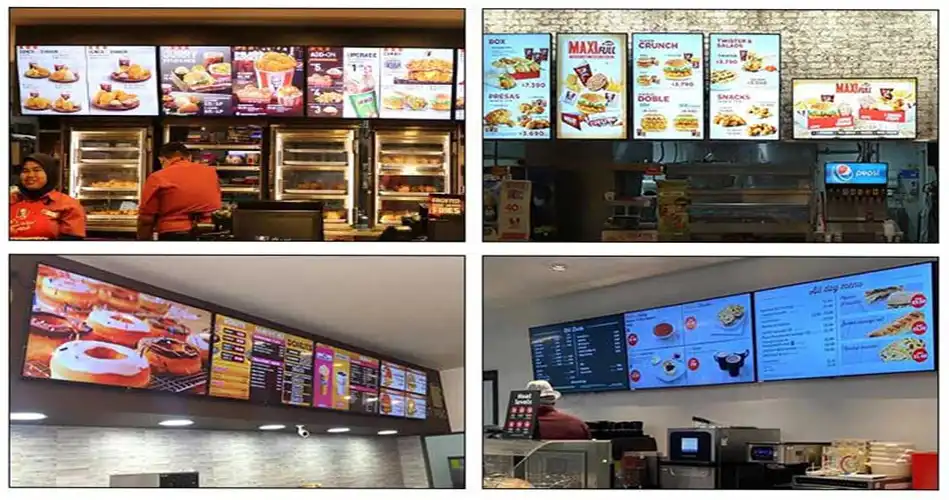
A complete overview of Bar LCD Displays, including technical features, industry applications, installation methods, customization options, and common buyer questions.
Bar LCD Display Overview #
The Bar LCD Display is a stretched LCD panel designed with an ultra-wide aspect ratio, ranging from 8.6 inches to 86 inches. Compared with traditional 16:9 displays, these elongated screens are well suited to environments where space is limited but strong visual communication is still required. They are widely used in digital signage, retail, transportation, and corporate advertising.
Thanks to their slim profile, Bar LCD Displays can be integrated into shelves, cabinets, buses, trains, and exhibition environments. They are especially useful for businesses that want a combination of modern appearance and practical communication performance.
Key Features of Bar LCD Displays #
- Ultra-wide format: Aspect ratios such as 16:3, 32:9, or customized formats are suitable for narrow spaces.
- Wide size range: Available from compact 8.6-inch modules to large 86-inch panels.
- High brightness: Suitable for stronger ambient-light conditions in commercial installations.
- Durability: Designed for long operating hours and continuous-use scenarios.
- Energy efficiency: Optimized to reduce operating cost over time.
- Flexible installation: Can be wall-mounted, embedded, shelf-mounted, or freestanding.
- Wide viewing angles: Helps preserve readability and image consistency across different positions.
- Interface compatibility: Supports common integration options such as HDMI, VGA, LVDS, and USB depending on the model.
Technical Specifications #
Below are representative specifications for a typical Bar LCD Display series from 8.6 to 86 inches. Final model details can be customized according to project requirements.
| Model | Size | Resolution | Brightness | Aspect Ratio | Typical Applications |
|---|---|---|---|---|---|
| BLD-086 | 8.6 inch | 1280 × 480 | 500 nits | 16:5 | Retail shelves and transportation signage |
| BLD-288 | 28.8 inch | 1920 × 540 | 700 nits | 32:9 | Digital signage and bus station display |
| BLD-400 | 40 inch | 3840 × 720 | 1000 nits | 32:9 | Malls and advertising display systems |
| BLD-860 | 86 inch | 3840 × 1080 | 1500 nits | 32:9 | Large-format advertising and exhibition use |

Advertisement Display Applications #
The Advertisement Display powered by Bar LCD technology is changing how businesses engage customers. By integrating with a content management system, organizations can deliver dynamic, targeted, and real-time advertising more efficiently.
- Retail stores: Useful for product promotion, shelf-edge pricing, and campaign messaging.
- Transportation: Installed in buses, subways, and trains for route updates and advertising.
- Corporate and exhibitions: Supports storytelling, event presentations, and brand messaging.
- Outdoor advertising: High-brightness models improve visibility in stronger daylight conditions.
Installation and Integration #
One of the key concerns for customers is how easily a Bar LCD Display can be installed and integrated. These displays generally support multiple installation methods:
- Wall-mounted: Suitable for showrooms, malls, and architectural display areas.
- Embedded: Integrated into cabinets, shelves, kiosks, or custom structures.
- Freestanding: Used with floor stands in exhibitions and public spaces.
- Vehicle-mounted: Adapted for buses, trains, and mobile advertising systems.
Depending on the model, displays can be integrated with HDMI, VGA, and LVDS interfaces, making connection with media players, PCs, and embedded systems more straightforward.

Industries Using Bar LCD Displays #
Bar LCD Displays and Advertisement Displays are used across a wide range of industries to improve visibility and communication efficiency.
- Retail: Supermarkets, convenience stores, and shopping malls.
- Transportation: Airports, bus stations, train platforms, and onboard systems.
- Hospitality: Hotels, restaurants, and entertainment environments.
- Corporate: Office buildings, exhibitions, and brand promotion spaces.
- Public services: Museums, libraries, and educational institutions.
Customization Options #
Different projects often require different display configurations. For this reason, Bar LCD Displays can usually be customized in several areas:
- Screen size: From 8.6 inch to 86 inch depending on project needs.
- Brightness levels: Standard indoor brightness or higher-brightness outdoor-oriented options.
- Resolution: From lower-resolution compact formats to ultra-high-resolution larger displays.
- Interfaces: Options may include HDMI, USB, VGA, RS232, and wireless connectivity support.
- Mechanical design: Open-frame, enclosed, or weather-resistant housing structures.
Bar LCD vs. Traditional Advertisement Display #
| Feature | Bar LCD Display | Traditional Advertisement Display |
|---|---|---|
| Aspect Ratio | Ultra-wide and elongated formats | Usually standard 16:9 or 4:3 |
| Design Flexibility | Fits shelves, buses, and narrow architectural spaces | Usually uses larger flat-panel formats |
| Brightness | Can support higher-brightness commercial configurations | Often optimized for standard indoor signage |
| Applications | Retail shelves, transportation, malls, embedded systems | Indoor signage, conventional advertising, general display walls |
| Energy Efficiency | Often optimized for long-duration commercial use | Varies depending on format and system type |

Frequently Asked Questions #
1. What is a Bar LCD Display?
A Bar LCD Display is a stretched display with an ultra-wide aspect ratio, designed for space-limited environments such as retail shelves, transportation signage, and embedded advertising systems.
2. What sizes are available?
Bar LCD Displays are available in a wide size range, commonly from 8.6 inches up to 86 inches, depending on the product series and customization requirements.
3. Are Bar LCD Displays suitable for outdoor use?
Yes, high-brightness models can be configured for outdoor or semi-outdoor applications when matched with the correct enclosure and environmental protection design.
4. Can these displays run 24/7?
Commercial models are typically designed for continuous operation and long service life, making them suitable for 24/7 use scenarios.
5. Do you provide customization?
Yes, customization can include brightness, size, interfaces, mechanical housing, and other project-specific requirements.
6. What industries benefit most from Bar LCD Displays?
Retail, transportation, hospitality, corporate environments, and public services are among the main industries using Bar LCD Displays.


Hinterlasse einen Kommentar
Diese Website ist durch hCaptcha geschützt und es gelten die allgemeinen Geschäftsbedingungen und Datenschutzbestimmungen von hCaptcha.