
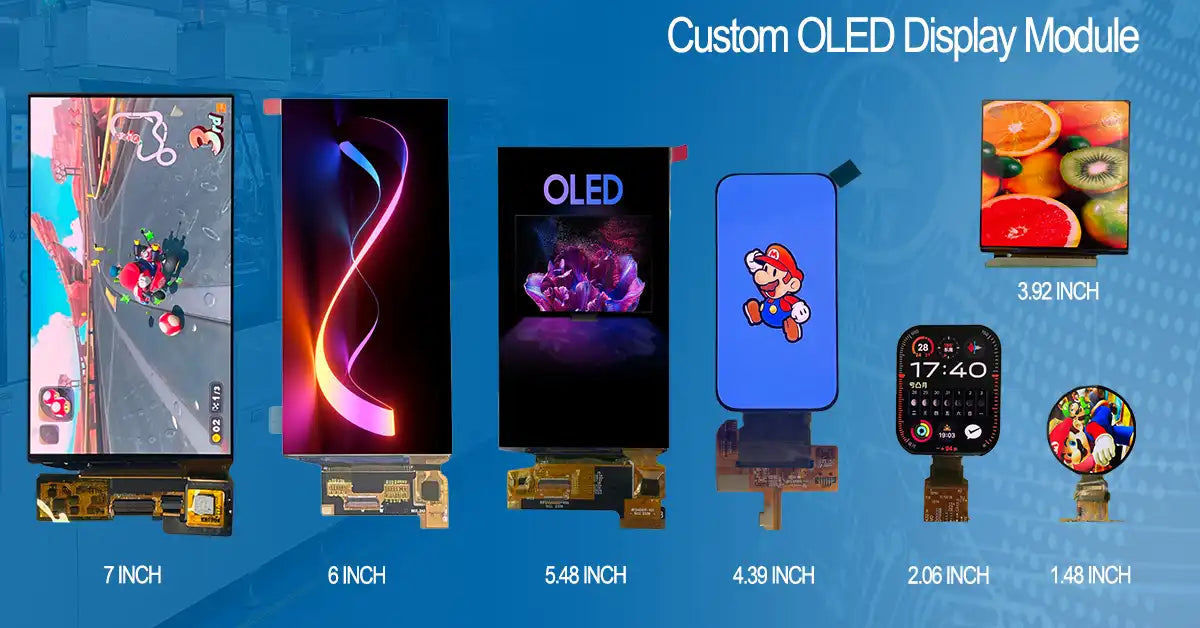
Stop compromising your product design to fit standard components. As a premier OLED manufacturer, BROWNOPTO explains how to customize every layer of your display stack for medical, industrial, and consumer applications.
1. Why Off-the-Shelf Often Fails in Mass Production
In the prototyping phase, a standard 0.96-inch OLED or a generic 2.4-inch TFT from a distributor may be sufficient. However, as you move toward mass production, standard modules often become the bottleneck of product innovation.
We frequently see clients struggle with:
- Mechanical Conflicts: The standard FPC tail exits from the bottom, but your battery is located there.
- Interface Mismatch: Your MCU only supports SPI, but the high-resolution screen you want is configured for MIPI or parallel.
- Outdoor Readability: Standard consumer displays wash out under direct sunlight.
- Durability Issues: Standard glass cannot survive the IK08 impact test required for industrial handhelds.
At BROWNOPTO, we do not just sell screens. We engineer display solutions. Customization allows you to define the form factor, the interface, and the durability, ensuring the display serves your product instead of forcing your product to adapt to the display.
2. FPC Customization: The Nervous System
The Flexible Printed Circuit, or FPC, is the most common customization request. It is the bridge between the delicate glass panel and your motherboard. Modifying the FPC is often the most cost-effective way to integrate a display into a tight mechanical housing.
A. Shape and Routing
Standard FPCs are usually straight rectangles. However, modern wearables and IoT devices are rarely rectangular. We can design FPCs in L-shapes, U-shapes, or S-shapes to route around internal components such as batteries, antennas, or mounting screws.
When designing a custom FPC, we must account for the bend radius. For static bends, where the FPC is folded once during assembly, the radius should be at least ten times the FPC thickness. For dynamic bends, such as those in flip devices, special rolled annealed copper should be used instead of standard electro-deposited copper to reduce fatigue cracking risk.
B. Interface Conversion and Pin Definition
The driver IC, such as SSD1306 or ST7789, often supports multiple interfaces including SPI, I2C, parallel, and MIPI, but standard modules usually lock you into one configuration. With a custom FPC, we can:
- Switch Interfaces: Hardwire the IM0, IM1, and IM2 pins on the FPC to select SPI instead of parallel, saving more GPIO resources.
- Reorder Pins: Match the pinout of the display FPC to your existing PCB connector, eliminating the need for adapter boards.
- Integrate Components: Mount capacitors, resistors, and even DC-DC boost converters directly onto the FPC, reducing motherboard complexity and BOM pressure.
C. EMI Shielding
For medical and military applications, electromagnetic interference is a critical factor. We can add a conductive silver foil layer or a grounded copper mesh layer to the FPC. This helps shield high-speed data signals, especially MIPI DSI, from interfering with nearby RF antennas such as GPS, Wi-Fi, or Bluetooth.

3. Touch Panel Integration: Beyond Simple Taps
Adding touch functionality transforms a display into an HMI. We offer three primary integration methods, depending on your thickness target, budget, and product positioning.
| Technology | Structure | Thickness | Cost | Best Application |
|---|---|---|---|---|
| Out-Cell (Discrete) | Sensor on separate glass or film | Thickest, about 1.5 mm and above | Low | Industrial controls, retrofitting |
| On-Cell | Sensor on top of OLED glass | Medium | Medium | Smartphones, handheld devices |
| In-Cell | Sensor inside the OLED pixels | Thinnest | High | Premium wearables, high-end mobile devices |
Capacitive Touch Panel Customization
We use IC platforms from Goodix, FocalTech, and Cypress. However, hardware is only part of the solution. We also customize firmware behavior to match the application environment:
- Water Rejection: Essential for marine or outdoor equipment. We tune the mutual capacitance threshold so rain droplets are ignored while finger input is still recognized.
- Glove Touch: By increasing signal gain, users wearing industrial or medical gloves can still operate the screen.
- Thick Cover Glass Support: Standard touch sensors often work through 0.7 mm glass. We can tune the sensor to work through up to 6 mm of reinforced glass for kiosk or ATM applications.

4. Cover Glass: The Face of Your Product
The cover lens, or cover glass, is the only part of the device your user physically touches. It strongly influences both the premium feel and the long-term durability of the product.
Materials
- Soda-Lime Glass: Standard and cost-effective, suitable for many indoor applications.
- Aluminosilicate Glass: Chemically strengthened and highly resistant to scratches and drops, making it ideal for rugged equipment.
- PMMA / PC: Plastic options for applications requiring shatter resistance, such as food processing environments where glass fragments are unacceptable.
Surface Treatments
To improve readability and usability, we apply vacuum-deposited surface coatings:
- AG (Anti-Glare): Diffuses reflections and improves usability under strong lighting.
- AR (Anti-Reflective): Reduces surface reflection and improves contrast, especially for outdoor readability.
- AF (Anti-Fingerprint): Adds an oleophobic layer that resists oil and sweat, improving touch feel and cleanability.
Challenge: A client designing a portable defibrillator needed a display that remained readable under bright hospital lighting while also tolerating repeated cleaning with alcohol wipes.
BROWNOPTO Solution: We produced a custom 2 mm thick strengthened cover lens, applied an AG coating to manage reflections, and added a durable AF coating validated for repeated alcohol abrasion cycles. We also printed the client logo behind the glass using high-temperature ink.

5. Optical Bonding vs. Air Bonding
How the cover glass or touch panel is attached to the OLED display is critical for optical performance, durability, and environmental resistance.
Air Bonding
Double-sided adhesive tape is used around the perimeter, leaving an air gap between the glass and the display.
Pros: Lower cost and easier rework.
Cons: Lower contrast due to internal reflection, and higher risk of dust or condensation inside the gap in humid conditions.
Optical Bonding
We use optically clear adhesive or resin to fill the entire gap between layers.
Pros:
- Reduced Reflection: Eliminates the air gap and improves visual depth and color performance.
- Higher Durability: The solid bonding layer acts as a shock absorber and can improve impact resistance.
- No Internal Fogging: Moisture cannot condense inside the bonded stack.
Cons: Higher process cost.
For outdoor, industrial, or premium consumer devices, optical bonding is strongly recommended because the improvement in sunlight readability, durability, and long-term stability usually outweighs the incremental cost.
6. The Customization Process
Many buyers assume that custom means expensive or slow. In practice, a structured engineering process makes customization predictable and manageable.
Step 1: Evaluation
You send us your PCB drawing or mechanical constraints. Our engineers evaluate feasibility and recommend the appropriate driver IC and FPC routing approach.
Step 2: NRE and Drawing
NRE (Non-Recurring Engineering) Cost:
- FPC tooling is typically a relatively low-cost item.
- Custom cover glass cost depends on size, shape, and process complexity.
- NRE is a one-time fee and may be refunded if production volume reaches an agreed target.
Step 3: Sampling
We produce engineering samples for your verification and provide initialization code plus debugging support to accelerate evaluation.
Step 4: Mass Production
Once samples are approved, we move into volume production.
Typical MOQ:
- Custom FPC: usually around 1,000 pieces
- Custom glass: usually around 1,000 pieces
7. Frequently Asked Questions
Below are some of the most common questions from B2B partners regarding customization, engineering support, and supply continuity.
What is the minimum order quantity for a fully custom module?
Is the NRE fee refundable?
How do you handle end-of-life risk for critical components?
Can you provide initialization code for a specific MCU platform?
Do you offer optical bonding for curved or circular displays?
Ready to Build Your Custom Display?
Do not let standard components limit your product potential. Send us your requirements, and our engineering team can help develop a display solution that matches your mechanical, electrical, and optical targets.
Request a Quote and Engineering ReviewDirect Factory Support | NDA Available | ISO9001 Certified

Leave a comment
This site is protected by hCaptcha and the hCaptcha Privacy Policy and Terms of Service apply.