
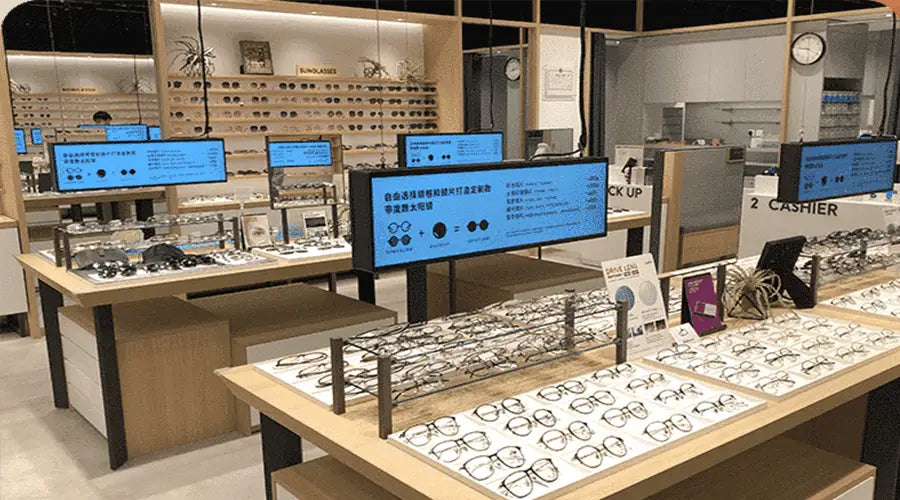
In the rapidly evolving landscape of digital signage and industrial interface design, the standard 16:9 aspect ratio is no longer the universal solution. As architects, engineers, and retail designers push the boundaries of space utilization, a specialized hardware category has emerged to dominate the market: the Bar LCD Stretched Display.
Often referred to as ultra-wide displays, shelf-edge screens, or resizing LCDs, these unique visual modules are transforming static surfaces into dynamic communication channels. From the narrow headers of subway cars to the shelf edges of luxury boutiques, Bar LCDs are maximizing the value of every square inch of commercial real estate.
This is not merely a design trend; it is a fundamental shift in B2B display technology. This comprehensive guide, spanning technical engineering to commercial strategy, provides an in-depth analysis of integrating Bar LCD Stretched technology into your next project.
Table of Contents
- 1. Defining the Bar LCD Stretched Display
- 2. Engineering Mechanics: Native vs. Cut Panels
- 3. Critical Technical Specifications for Buyers
- 4. Strategic Industry Applications
- 5. Content Management & Software Configuration
- 6. Installation, Thermal Management & Cabling
- 7. Procurement Guide: Customization & MOQ
- 8. Frequently Asked Questions (FAQ)
1. Defining the Bar LCD Stretched Display
A Bar LCD Stretched Display is a liquid crystal display panel that features an aspect ratio significantly wider than traditional monitors. While a standard consumer television utilizes a 16:9 ratio, a Bar LCD is engineered with ratios such as 16:3, 32:9, or even highly customized formats like 58:9.
These displays are specifically engineered to fit into long, narrow spaces where a standard rectangular screen would be physically impossible to install or aesthetically intrusive. Despite their unique shape, they retain all the core benefits of industrial TFT-LCD technology—high color gamut, fast response times, and high resolution—packaged in a form factor that mimics a "strip" or a "bar."
The "Attention Economy" Driver
The surge in demand is driven by the "Attention Economy." In crowded public spaces, traditional billboards are often ignored due to visual fatigue. However, a high-brightness, animated strip display placed directly on a supermarket shelf (the "Point of Decision") captures consumer attention instantly. Similarly, in industrial machinery, operators require panoramic data visualization without the vertical bulk of a large square monitor blocking their line of sight.
2. Engineering Mechanics: Native vs. Cut Panels
Understanding the manufacturing process is crucial for making an informed purchasing decision regarding durability and cost. There are two primary methods of manufacturing Bar LCDs.
Method A: Native Photomask Manufacturing
In this method, the glass substrate is originally manufactured in the wide bar format at the factory level (Gen 8.5 or Gen 10 plants). The internal circuits and thin-film transistors (TFTs) are laid out specifically for this aspect ratio from the start.
- Advantages: Extremely stable; zero risk of seal leakage; generally lower unit cost for massive volume orders (10,000+ units).
- Disadvantages: Extremely high initial tooling costs (NRE); very limited variety of standard sizes available.
Method B: Panel Cutting Technology (Resizing)
This is the most common method for diverse B2B projects. Manufacturers take a standard industrial panel (e.g., a 32-inch or 43-inch 16:9 panel) and utilize precision laser cutting technology to slice it to the desired height.
The Science of LCD Cutting
Cutting an LCD is a delicate, high-precision process. It involves cutting the glass substrate, instantly sealing the liquid crystals to prevent leakage, and redesigning the circuit board (PCBA) to drive the remaining pixels. A high-quality supplier ensures that the cut edge is sealed with industrial-grade UV adhesives that prevent moisture ingress and the formation of "black spots" over years of operation.
- Advantages: Highly customizable sizes (height can be defined by the client); lower Minimum Order Quantity (MOQ).
- Disadvantages: Requires a supplier with advanced sealing technology to ensure longevity and warranty support.

3. Critical Technical Specifications for Buyers
When reviewing a datasheet for a Bar LCD, several specifications carry more weight than they do for standard consumer electronics.
| Specification | Importance for Bar LCDs |
|---|---|
| Brightness (Nits/cd/m²) | Standard screens are typically 250 nits. Bar LCDs often require 700 to 2500 nits because they are frequently deployed in brightly lit retail stores or semi-outdoor transport hubs. |
| Operating Temperature | Industrial applications require a range of -20°C to +70°C. Standard consumer panels will suffer from "isotropic failure" (turning black) if exposed to direct sunlight or high heat. |
| Viewing Angle | IPS (In-Plane Switching) technology is mandatory. Bar displays are often viewed from below (shelves) or extreme side angles (hallways). TN panels will exhibit color inversion, rendering the content unreadable. |
| Interface Protocols | LVDS, HDMI, or MIPI. It is vital to ensure your media player supports the non-standard EDID (resolution data) of the bar screen. |
| Surface Treatment | Anti-Glare (AG) coating is essential for retail environments to prevent overhead LED lights from reflecting off the screen and obscuring the content. |
4. Strategic Industry Applications
The versatility of Bar LCD Stretched Displays allows them to serve multiple vertical markets effectively. Below is a detailed look at primary use cases.
Smart Retail & Shelf Edge Technology
This is considered the "Killer App" for Bar LCDs. By replacing paper price tags with long LCD strips (e.g., 23.1 inch, 35 inch, or 48 inch), retailers can achieve digital transformation:
- Dynamic Pricing: Update prices instantly across all chain stores via ERP integration.
- Brand Storytelling: Play high-definition video advertisements for products sitting immediately adjacent to the screen.
- Split-Screen Utility: Utilize the width to show Price on the left, and a promotional video on the right.
Public Transportation (PIS - Passenger Information Systems)
Space inside a bus, train, or metro car is at a premium. Stretched displays are the standard solution for:
- Route Maps: Installed above doors to show dynamic route progress that updates via GPS.
- Header Ads: Replacing static cardboard advertisements in the ceiling curve with digital ad revenue streams.
- Wayfinding: Displaying flight information on narrow pillars or above check-in counters in airports.
Industrial HMI & Automation
In factory automation, operators often need to monitor a timeline of data or a wide schematic of a production line. A 16:3 aspect ratio screen allows for a panoramic view of the process flow without forcing the operator to scroll horizontally, improving reaction times and safety.
Gaming & Casino
Slot machines utilize stretched LCDs in the "Button Deck" (where players physically press buttons) to create interactive, changing button labels, and in the "Top Box" for attracting attention with jackpot animations.

5. Content Management & Software Configuration
Hardware is only half the equation. A common challenge for integrators is: "How do I create content for such a non-standard shape?"
Resolution Management & EDID
Most Bar LCDs possess unique native resolutions, such as 1920x360 or 3840x600. If a standard 1920x1080 signal is forced onto the screen, the image will appear compressed or stretched.
The Solution: You must configure your media player (Android, Windows, or Linux) to output the specific EDID resolution of the panel. Most professional digital signage CMS software allows you to define custom canvas sizes pixel-by-pixel.
Zoning and Split-Screen
Because the screen is exceptionally wide, it is often best utilized by splitting the canvas into zones. For example, a 30-inch bar display can be treated as three separate 10-inch 4:3 zones. Zone A displays the brand logo, Zone B displays local weather, and Zone C displays a scrolling news ticker.
6. Installation, Thermal Management & Cabling
Installing a Bar LCD requires different considerations than mounting a standard television.
Heat Dissipation
High-brightness backlights (1000+ nits) generate significant thermal energy. In a tight enclosure (like a shelf edge), this heat can accumulate and damage components.
Best Practice: Ensure the enclosure has passive airflow vents or utilize an aluminum chassis that acts as a heatsink. For outdoor units, active cooling fans are required.
Mounting Standards
While some larger Bar LCDs use VESA mounts, smaller shelf-edge strips often use Side Mounting Brackets or Magnetic Strips for rapid deployment on retail shelving systems.

7. Procurement Guide: Customization & MOQ
As a B2B buyer, understanding the supply chain dynamics is essential for project success.
Standard vs. Custom Sizes
There are "Industry Standard" cut sizes that are readily available (e.g., 19", 24", 28", 37"). Selecting these sizes results in faster lead times (typically 2-3 weeks).
If a specific length is required to fit a unique machine (e.g., exactly 543mm width), a custom cut is possible. However, this usually requires an MOQ (Minimum Order Quantity) of 50-100 units and a longer lead time for tooling and validation.
Touch Screen Options
Interactivity is increasingly requested. Most Bar LCDs can be fitted with PCAP (Projected Capacitive) Touch glass. This transforms the display into an interactive kiosk. Ensure the touch controller supports the unusual aspect ratio to avoid "dead zones" in the touch response.
8. Frequently Asked Questions (FAQ)
Q1: Can I use a standard PC to drive a Bar LCD?
Yes. As long as your graphics card (GPU) allows for custom resolution settings (e.g., via NVIDIA Control Panel or Intel Graphics Command Center), you can drive these displays via standard HDMI or DisplayPort connections.
Q2: What is the expected lifespan of a Stretched LCD?
Industrial-grade Bar LCDs typically feature a backlight lifespan of 50,000 hours (time to half-brightness). This equates to roughly 5-6 years of 24/7 continuous operation.
Q3: Is the "Cut" panel fragile?
No. Once the panel is cut and resealed, it is reinforced with a metal frame (bezel) and often covered with protective glass. They are robust enough for public environments.
Q4: Do you provide the controller board?
Yes. Most Bar LCD modules are sold as a complete "Kit," including the LCD panel, the AD board (Driver board), and the cable harness. You simply need to provide power (usually 12V or 24V DC) and a video signal.
Looking for a specific size or a custom solution for your project? Contact our engineering team today to discuss how Bar LCD Stretched Displays can elevate your product design.

Leave a comment
Este site está protegido pela Política de privacidade da hCaptcha e da hCaptcha e aplicam-se os Termos de serviço das mesmas.