
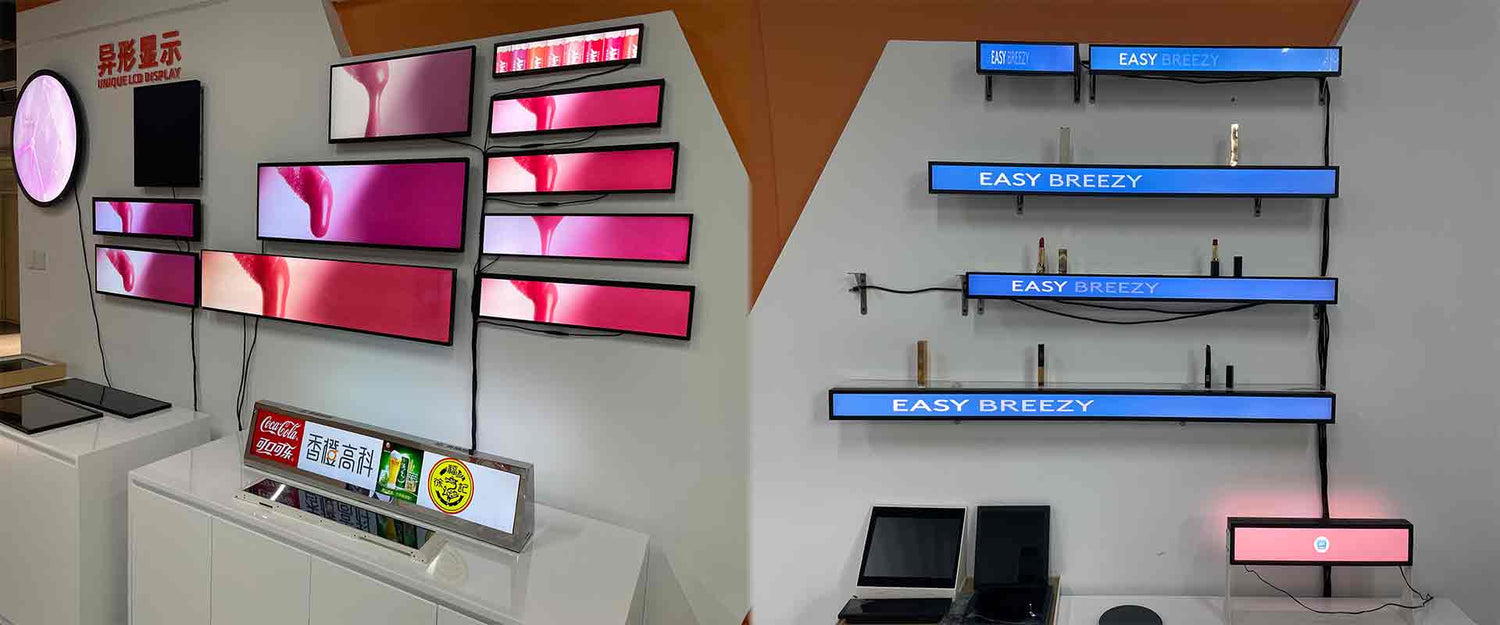
The digital signage landscape is undergoing a radical transformation. As businesses move deeper into 2026, the era of forcing content into standard 16:9 rectangles is ending. The future belongs to adaptability, and the bar LCD display is leading that shift. These elongated screens unlock new space for information and advertising in locations that traditional formats cannot use efficiently.
Whether you are designing a smart retail shelving system or sourcing hardware for a transportation upgrade, understanding the technical structure of a stretched bar LCD display is essential. This guide covers terminology, manufacturing approaches, industrial specifications, integration paths, and deployment considerations in one complete format.
1. Defining the Technology: Terminology and Synonyms
One of the first challenges in sourcing these modules is the lack of standardized naming. In the global market, a stretched LCD display may be listed under many different names. Buyers, engineers, and integrators should recognize these terms to locate the right products and compare specifications accurately.
A bar LCD display is defined mainly by its elongated aspect ratio, which is much wider than it is tall, such as 16:3, 32:9, or other custom proportions. Common industry terminology includes the following:
- Ultra-Wide LCD Display: A term that emphasizes panoramic width and is often used in immersive visual applications.
- Wide Bar LCD Screen: A descriptive phrase commonly used in commercial product listings.
- Elongated LCD Display: A label focused on the physical shape of the display.
- Narrow Bar LCD Display: Often used for low-height displays designed for shelf edges and compact installations.
- Ultra-Long LCD Screen: A term frequently associated with transport and route-map applications.
- Wide Aspect Ratio LCD: A more technical description referencing the display geometry.
- Non-Standard LCD Display: A broader category distinguishing these products from conventional monitor sizes.

2. Manufacturing Technology: Native vs. Cut Panels
When selecting a bar LCD module, understanding the manufacturing process is important for evaluating long-term reliability, scalability, and cost. Two main production methods dominate the market.
Method A: Cut Panel Technology
Historically, many stretched bar LCD display units were created by cutting standard 16:9 LCD glass into narrower forms. Precision processes are used to reshape the panel, reseal the structure, and reconnect the required circuitry.
Advantages: Lower cost for smaller runs and broad flexibility based on commonly available mother glass sizes.
Considerations: If poorly executed, cut edges may create sealing or durability concerns. With improved processes, custom bar LCD display cutting has become far more reliable than in earlier years.
Method B: Native Photomask
For higher-volume applications, manufacturers can produce the panel directly in bar format using a dedicated photomask. This approach is commonly used for repeatable standard sizes such as shelf edge LCD display models deployed at scale.
Advantages: Stronger structural consistency, fewer risks associated with glass cutting, and improved yield in mass production.
Considerations: Higher tooling cost and less flexibility for unusual or low-volume dimensions.
3. Critical Technical Parameters for 2026
To ensure a bar LCD display performs effectively in real deployment conditions, attention should be given to brightness, resolution, aspect ratio, and viewing angle.
Brightness
Standard monitors often operate around 250 to 300 nits, but a commercial bar LCD display may need substantially higher brightness to remain visible under strong retail lighting or near windows.
- Indoor retail: A typical target range is 500 to 700 nits.
- Semi-outdoor or window-facing placement: High brightness models may require 1000 to 2500 nits depending on ambient light conditions.
Resolution and Aspect Ratio
Because these are non-standard LCD display units, their pixel dimensions may appear unusual, such as 1920 × 360 or 3840 × 600. The content management system must support these native resolutions so visual assets display correctly without distortion.
Viewing Angle
For shelf edge LCD display applications, vertical visibility matters as much as horizontal visibility. IPS technology is commonly preferred because it supports wide viewing angles and helps preserve color consistency when shoppers look at the screen from above or from the side.

4. Application Scenarios: Where Form Meets Function
The distinctive shape of the stretched LCD display allows it to be installed in narrow, high-visibility zones that were previously limited to static signage. Key applications include the following:
Retail Revolution
Shelf edge LCD display and digital shelf display systems are replacing paper labels in many modern retail environments. A retail bar LCD display can support rapid pricing updates, synchronized promotions, and branded video content placed directly next to merchandise.
Digital Signage and Branding
In shopping centers and commercial interiors, the advertising bar LCD screen is commonly installed on headers, pillars, and architectural gaps. A digital signage bar LCD can create a continuous visual strip across entrances, fixtures, and interior branding zones.
Transportation Hubs
Transportation information display systems often rely on ultra-long LCD screen formats. These are ideal for route maps, next-stop updates, and passenger messaging in buses, trains, and station environments. Similar formats are also used as elevator bar LCD displays for floor guidance and information panels.
Food and Beverage
Menu board bar LCD systems are increasingly used in quick-service and hospitality settings. Their low-height format allows them to fit above counters while preserving wall space and maintaining a modern visual presentation.
5. B2B and Industrial Purchasing Guide
Sourcing for industrial and B2B projects requires a different evaluation process from standard commercial procurement. Reliability, environment tolerance, and customization support are especially important.
Industrial Grade Reliability
An industrial bar LCD display is designed for demanding operating conditions and continuous use. Depending on the model and project requirements, important features may include:
- Wide temperature support: Useful for factories, transit systems, and outdoor-adjacent installations.
- Protective board treatment: Helps reduce risk from dust and humidity.
- Vibration resistance: Important for transportation and moving equipment.
Customization and OEM Services
The OEM bar LCD display market continues to grow because project requirements are rarely identical. A custom bar LCD display program may include changes to physical dimensions, brightness level, enclosure style, interface configuration, and mounting structure.
- The glass size can be adapted to precise installation needs.
- Brightness can be adjusted through backlight configuration.
- Housing options may include metal, open-frame, or plastic structures.

6. Smart Integration: Android and Touch Capabilities
In modern deployments, a display is often expected to function as an intelligent terminal rather than a passive output device.
Android Bar LCD Display
An Android bar LCD display includes an integrated motherboard or system-on-chip platform that enables local playback, networking, and remote content updates. This all-in-one design can reduce cabling complexity and eliminate the need for a separate media player.
Touch Bar LCD Display
A touch bar LCD display adds interactive functionality to the elongated format. PCAP technology is widely used for these models, making them suitable for machine interfaces, interactive wayfinding, smart retail shelves, and other user-driven applications.
7. Installation and Thermal Management
Due to the compact shape of a bar LCD module, thermal management can become a major design concern, especially in high-brightness configurations. When integrating a wide aspect ratio LCD into an enclosure, it is important to maintain sufficient airflow and heat dissipation.
For outdoor or high-load applications, active cooling or aluminum heat sink structures may be required to protect performance and lifespan. Proper thermal design helps prevent display degradation and improves operational stability over time.
8. Frequently Asked Questions
What is the difference between a commercial and an industrial bar LCD display?
A commercial bar LCD display is typically intended for standard indoor environments and lighter duty schedules. An industrial bar LCD display is designed for more demanding use cases, including extended operating hours, tougher environmental conditions, and stronger resistance to vibration or temperature variation.
Can I order a custom bar LCD display with a specific size?
Yes. Through OEM bar LCD display services, manufacturers can often provide custom dimensions, brightness levels, and housing structures. Custom projects may require minimum order quantities and development-related setup costs.
How do I create content for a non-standard LCD display?
Content should be designed using the exact native resolution of the target screen. Standard 16:9 assets should not be reused without adaptation, because they will appear stretched or cropped on an elongated display.
What is a shelf edge LCD display used for?
A shelf edge LCD display is a narrow digital screen mounted on retail shelving. It is commonly used for pricing, promotions, product information, and brand messaging at the point of purchase.
Does an Android bar LCD display need an external media player?
No. In many cases, the built-in Android system provides the processing, storage, and networking required for content playback and remote management without an additional external player.
Are touch bar LCD displays available?
Yes. Touch-enabled models are available and are often used for industrial control panels, self-service interfaces, interactive retail systems, and smart equipment panels.
9. Partner with the Leading Bar LCD Display Manufacturer
Sourcing the right bar LCD module is only part of a successful project. Choosing a capable supplier helps ensure reliable production, stable quality, and long-term support. We focus on high-quality bar LCD display solutions for commercial and industrial applications worldwide.
Why work with us as a long-term partner?
- Factory direct support: Competitive pricing for wholesale bar LCD display projects.
- OEM and ODM capability: Support for custom bar LCD display sizing and housing development.
- Quality assurance: Rigorous testing for brightness, temperature stability, and service life.
- Broad product range: From shelf edge LCD displays to high-brightness commercial solutions.
Ready to discuss your project? Request a quote today.
Email: info@brownopto.com
WhatsApp / WeChat: +8617748574559


댓글 남기기
이 사이트는 hCaptcha에 의해 보호되며, hCaptcha의 개인 정보 보호 정책 과 서비스 약관 이 적용됩니다.