
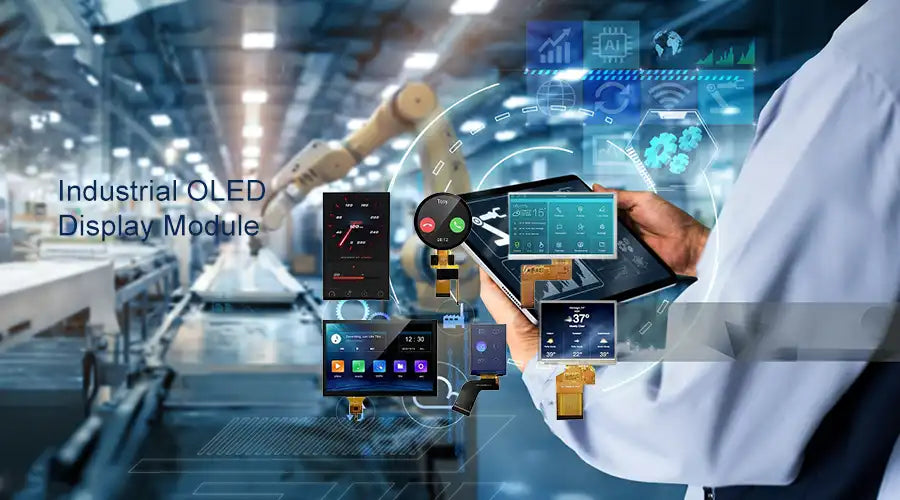
Industrial applications need displays that are not only visually strong but also stable, durable, and practical to integrate. Industrial OLED display modules bring the main advantages of OLED technology—true black, high contrast, and wide viewing angles—into products that must work in tougher environments. In industrial use, that usually means extended temperature support, stronger sealing, dependable long-term operation, and interface options that fit embedded systems and control platforms. This article covers the basics, the main specifications worth checking, integration points, and a simple selection framework for engineering and sourcing teams.
What is an industrial OLED display module?
An industrial OLED display module is a packaged OLED display unit that usually includes the OLED panel itself, driver electronics, connection interface, and the mechanical parts needed for system integration. Depending on the product, it may also include a front cover, optical bonding, a touch layer, or a mounting frame.
Compared with consumer-grade modules, industrial OLED versions are typically built for stricter operating conditions. These may include wider temperature ranges, improved sealing against moisture and dust, longer product availability, and design support for continuous or semi-continuous operation.
- Extended operating temperature ranges, such as \( -30^\circ\text{C} \) to \( +85^\circ\text{C} \)
- Better resistance to vibration, shock, and environmental exposure
- Longer lifecycle planning and more stable supply
- Optional features such as optical bonding, anti-reflective coatings, and reinforced front glass

Construction and design considerations
Panel and backplane
Industrial modules often use AMOLED panels when higher resolution, faster refresh, or richer UI graphics are required. The backplane structure affects how the display behaves over time, including leakage, refresh flexibility, and long-term image stability. For equipment that shows mostly static interfaces, the backplane choice can have a noticeable effect on uniformity and aging behavior.
Encapsulation and cover
OLED materials are sensitive to oxygen and moisture, so encapsulation quality matters. Industrial modules usually use more robust sealing than consumer products. Depending on the design, this may involve glass encapsulation, edge sealing, or thin-film encapsulation on flexible panels. Cover materials may include strengthened glass, anti-reflective glass, or bonded front layers that improve both durability and optical performance.
Thermal management
Temperature has a direct effect on OLED lifetime and image consistency. For this reason, industrial modules often need a clear thermal path through the housing or mounting structure. Metal backplates, thermal pads, and heat-spreading elements are common ways to keep panel temperature under control during continuous use.

Critical specifications to evaluate
When comparing industrial OLED modules, it is better to focus on practical specifications rather than general marketing language. The following items usually matter most in real projects:
- Diagonal size and active area: Check the exact usable display area and outer dimensions.
- Resolution and pixel pitch: Important for text sharpness, UI layout, and viewing distance.
- Peak and sustained brightness: A high peak value does not always mean strong full-screen brightness.
- Contrast ratio: OLED usually performs very well here, but ambient light still affects perceived contrast.
- Color performance: Review color gamut, white point, and calibration consistency if image quality matters.
- Viewing angle: Useful for equipment that is read from the side or by more than one operator.
- Operating and storage temperature: Confirm both ranges, not just one headline figure.
- Lifetime data: Ask how luminance lifetime is measured, including brightness level and average picture load.
- Mechanical and protection data: Review shock, vibration, IP rating, and mounting constraints.
- Interface type: Confirm the display interface, power rails, connector type, and control method.
Electrical and mechanical interfaces
Common electrical interfaces
Industrial OLED modules are available with different interface options depending on panel resolution and the control board used in the system.
- MIPI DSI and eDP: Common in higher-resolution modules connected to modern processors.
- LVDS and parallel RGB: Still used in some industrial controller platforms and legacy systems.
- SPI or UART: More common in simpler monochrome or lower-resolution OLED modules.
- Power design considerations: Review voltage rails, startup behavior, inrush current, and any boost or bias requirements.
Mounting and mechanical considerations
Mechanical integration should be reviewed early. Engineers typically need clear drawings for the bezel opening, connector orientation, mounting points, thickness, and allowable assembly stress. In industrial products, sealing, EMI grounding, and cable routing are often just as important as the panel itself.
Environmental and reliability requirements
Temperature and humidity
If the module will be used in outdoor, vehicle, or factory environments, operating temperature and humidity performance need to be defined clearly. It is also useful to ask how the supplier handles thermal derating, condensation risk, and front-surface protection for UV or high-humidity conditions.
Shock, vibration, and lifecycle
For mobile equipment or machinery applications, shock and vibration data can be essential. Ask suppliers for the actual test standards used and the conditions under which lifetime claims are made. For OLED, it is also worth reviewing burn-in mitigation methods such as pixel shifting, compensation algorithms, and brightness management.
Integration best practices
Design for longevity
Many industrial interfaces show static icons, logos, or status bars for long periods. That makes display strategy important.
- Use darker UI themes where possible to reduce OLED stress.
- Apply pixel shifting or small UI movement to distribute wear.
- Limit high-brightness static elements and use automatic dimming where appropriate.
- Review actual duty cycle instead of relying only on nominal specs.
Calibration and factory tuning
If the display will be used for measurement, imaging, or brand-sensitive graphics, factory calibration matters. For multi-screen systems, it is also useful to ask for color matching data between units and across production batches.
EMC and grounding
Industrial systems often need tighter EMC control than consumer devices. The display module, controller board, cabling, and grounding scheme should be considered together. Shielding, filtered power design, and proper grounding points can make a large difference in final system stability.
OLED vs other display technologies in industry
No single display technology is best for every project. OLED has clear strengths, but the right choice depends on use case, brightness target, lifetime requirements, and cost limits.
| Metric | OLED (industrial) | Transmissive LCD | MicroLED |
|---|---|---|---|
| Contrast | Excellent, with true black | Moderate, affected by backlight leakage | Excellent |
| Peak brightness | Good, but full-screen brightness is more limited | High with strong backlight systems | Very high |
| Power use with dark UI | Low | Usually higher because of constant backlight | Depends on brightness and image load |
| Burn-in risk | Present and needs management | Low | Minimal |
| Temperature durability | Good with proper engineering | Good | Excellent |
Typical industrial use cases
Human-Machine Interfaces (HMI)
Control panels, factory terminals, and medical device interfaces often benefit from OLED’s strong contrast and wide viewing angle. In HMI systems with mixed graphics and status information, OLED can provide a cleaner visual result than many standard LCD solutions.
Instrumentation and analytical equipment
Laboratory instruments and measurement systems often need crisp readouts and stable image quality. OLED can work well in these products, especially when the application values contrast and compact design.
Vehicle and rail displays
Displays used in transport systems need to balance brightness, operating temperature, lifetime, and vibration resistance. In some cases, automotive-grade OLED modules are suitable. In others, high-brightness LCD or MicroLED may still be the better fit.

Quick specification checklist
This type of checklist is useful when sending an RFQ or comparing supplier options.
| Item | Requirement / Example |
|---|---|
| Model / Part | XX-YY-IPS-OLED-07-800 |
| Active area (mm) | 120.0 × 67.5 |
| Resolution | 1280 × 720 |
| Brightness | Peak 800 nits, sustained 300 nits full-field |
| Contrast | >100,000:1 typical |
| Interface | MIPI DSI (4-lane) + I2C touch |
| Operating temperature | \( -30^\circ\text{C} \) to \( +85^\circ\text{C} \) |
| Ingress protection | IP54 front, gasketed housing optional |
| Calibration | Factory color calibration and matching data if required |
FAQ
Are industrial OLED modules suitable for 24/7 operation?
Many are designed for continuous or near-continuous use, but the answer depends on brightness level, image pattern, and duty cycle. It is better to review lifetime data under conditions close to the actual application rather than rely on a generic claim.
How can burn-in be reduced in static HMI applications?
Good UI design helps a lot. Darker layouts, pixel shifting, periodic screen refresh behavior, and limiting static bright elements are common ways to reduce uneven aging.
Can industrial OLED modules be used outdoors?
Some can, especially when paired with high-brightness tuning, anti-reflective treatment, and suitable front glass. Outdoor use should always be checked together with thermal load and ambient light conditions.
What certifications or reports should buyers request?
That depends on the project, but common requests include environmental test reports, RoHS and REACH compliance, vibration or shock data, and any application-specific qualification documents.
What should be included in an RFQ?
At minimum, include display size, resolution, brightness target, interface, operating temperature, touch requirement, mechanical constraints, and estimated annual volume. It is also helpful to describe the actual UI duty cycle.
Conclusion and next steps
Industrial OLED display modules can be an excellent fit for equipment that values contrast, viewing quality, and compact display design. At the same time, they need more careful planning around heat, lifetime, and static-image behavior than many standard LCD solutions. The most practical approach is to define the real operating conditions early, compare suppliers using a fixed checklist, and validate sample units under the same duty cycle expected in the final product.
Share the size, brightness target, expected duty cycle, operating temperature range, interface, and annual volume. That usually makes supplier comparison much faster and more accurate.


댓글 남기기
이 사이트는 hCaptcha에 의해 보호되며, hCaptcha의 개인 정보 보호 정책 과 서비스 약관 이 적용됩니다.