
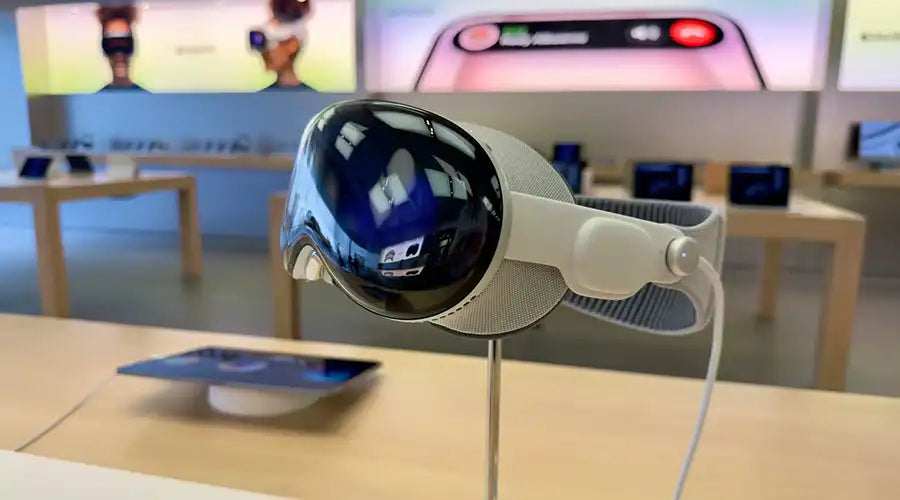
Deep analysis for product leaders and hardware engineers evaluating micro-AMOLED for AR glasses, XR headsets, and AI wearables.
Introduction — AR/XR Acceleration and Why Micro-Displays Matter
From late 2024 into 2025, the AR and XR sector entered a stronger scale-up phase. Better waveguide combiners, more useful AI-driven workflows, and stronger silicon support for spatial computing all increased the need for wearable visual systems that are sharp, stable, efficient, and comfortable for long sessions.
Conventional display stacks struggle to satisfy the combined requirements of high angular resolution, low persistence, compact optics, and wearable power budgets. That is why 1–2 inch AMOLED micro-displays are emerging as a leading choice: they combine high pixel density, fast response, deep contrast, and thin packaging in a form factor that suits near-eye optics.

What Are 1–2 Inch AMOLED Displays?
Definition of Small-Size AMOLED Modules
In this context, 1–2 inch AMOLED refers to active-matrix OLED modules with diagonals around 1.0 to 2.0 inches used as image sources in AR waveguides, birdbath combiners, and other near-eye optical engines. These modules integrate a TFT backplane, OLED emissive layers, and a compact interface structure suited for optical assemblies.
Typical Specifications
- Resolution and PPI: 800×800, 1024×1024, 1280×720, 1440×1440, often in the 400–600+ PPI range
- Refresh and persistence: 60–120 Hz modes with low-persistence drive options
- Brightness: panel-level brightness often around 800–2,000 nits depending on module class
- Interfaces: MIPI DSI is common, with SPI or I²C options in simpler designs
- Form factor: rigid thin-glass or ceramic-based micro-display packages
- Options: custom FPC, coatings, optical window treatment, and system-specific mechanics
Why 1–2 Inch Works for AR/XR Optics
This size range balances compact engine dimensions with enough native resolution for usable angular clarity after cropping, optical expansion, and waveguide efficiency losses. It also aligns well with the strict weight, thermal, and battery constraints of wearable AR products.

Why AMOLED Is Displacing LCD in AR/XR
True Black and Near-Infinite Contrast
Because AMOLED is self-emissive, it can produce true black at the pixel level. In transparent or semi-reflective optical paths, that materially improves overlay sharpness and readability.
Ultra-Fast Response and Low Persistence
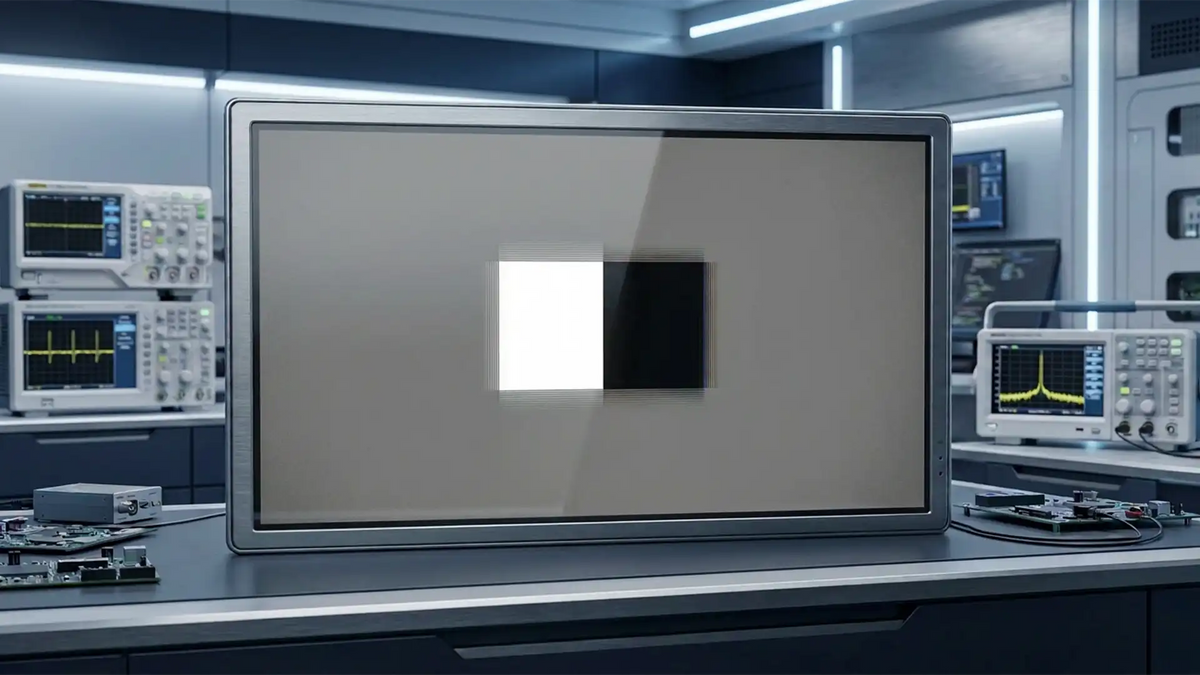
OLED’s response speed supports low-persistence driving, which helps reduce motion smear and visual discomfort in head-tracked systems.
High PPI for Retinal-Grade Clarity
Dense backplanes support the high angular resolution needed for micro-text, fine symbology, and clean UI edges in near-eye displays.
Power Advantages in Dark UI
AMOLED can lower power significantly when the interface is dark or sparse. This is valuable in notification-centric or assistive AR devices where average picture level stays low.
Thin, Light, and Integration-Friendly
Without a backlight and diffuser stack, AMOLED packages can be thinner and easier to integrate into compact optical engines, improving ergonomics and simplifying mechanical design.

AMOLED vs TFT LCD (1–2 Inch, AR/XR Context)
| Parameter | 1–2 Inch AMOLED | 1–2 Inch TFT LCD | AR/XR Implication |
|---|---|---|---|
| Pixel Density | 400–600+ | Usually lower | Sharper UI and better micro-text |
| Response and persistence | Very fast, low persistence possible | Slower, more blur | Cleaner motion and less smear |
| Contrast and black level | Very high | Limited by backlight | Improved overlay readability |
| Power in dark UI | Lower | Backlight remains active | Longer wearable runtime |
| Thickness and weight | Thinner stack | Thicker due to BLU | Lighter engine packaging |
| Burn-in risk | Needs mitigation | No OLED-style burn-in | Requires compensation and UI strategy |
Note: Modern AMOLED modules include per-pixel aging compensation. With UI strategies such as pixel shift, dynamic widgets, and dark themes, burn-in risk can be managed for many AR usage patterns.
Key Technical Requirements for AR/XR Displays
-
High Brightness for Waveguides
Waveguide combiners impose major optical losses. System brightness depends on coupling efficiency, propagation loss, exit pupil expansion, and eyebox design, not just panel nits.
-
Ultra-High Pixel Density
To reach strong angular resolution across useful FOV ranges, source PPI must remain high enough after cropping and optical transformation.
-
Low Persistence
Low-persistence drive reduces motion smear and improves comfort in dynamic use.
-
High Modulation and Contrast
Contrast preservation improves edge acuity and makes semi-transparent overlays more legible.
-
Wide Viewing Angle and Color Stability
Eyebox expansion requires stable color and contrast over angle. This is one reason OLED is favored in many optical engines.
Applications Across the AR/XR Ecosystem
Consumer AR Glasses
Navigation prompts, notifications, and glanceable AI responses benefit from dark UI efficiency and strong contrast.
Industrial Smart Glasses
Hands-free work instructions, pick-by-vision, and remote assistance require rugged optics, clean text rendering, and high visual stability.
Training and Simulation Headsets
Low persistence and strong angular resolution support long sessions with reduced fatigue.
XR Fitness and Entertainment
Fast motion benefits from OLED response speed and clean UI edge preservation.
Medical Visualization Devices
Fine symbology and annotations benefit from high PPI and stable color behavior.
2025 Market Forces Driving Adoption
AI-Powered Wearables
Always-available contextual assistants make on-head visual systems more useful, which increases demand for efficient micro-displays.
Big Tech Momentum
Large ecosystem players help de-risk supply, standardize interfaces, and bring down module cost through broader deployment.
Supply Chain Maturity
Improved yields, stronger compensation algorithms, and broader form-factor catalogs make AMOLED easier to deploy.
Cost Reduction
Material and manufacturing improvements continue lowering practical cost barriers for mainstream AR devices.
Engineering Considerations for B2B Buyers
Match Resolution and Brightness to the Optical Architecture
Model the full path from panel to eye. Budget for optical loss, distortion, modulation loss, and target angular resolution after expansion.
Choose the Right Interface
MIPI DSI is the mainstream choice for richer graphics and higher refresh. Simpler interfaces may work for low-bandwidth overlays, but bandwidth and EMI constraints must be checked carefully.
Lifetime, Burn-In, and Reliability
Prefer modules with compensation, calibration, and strong environmental validation. Pair the hardware with UI strategies that minimize static stress.
Customization
Custom FPC shape, connector orientation, coatings, and Z-height control often matter in tight optical packages.
- Resolution, PPI, refresh, and low-persistence capability
- Panel luminance, contrast, and APL derating
- Interface, pinout, power rails, and timing requirements
- Compensation features, lifetime reports, and burn-in mitigation
- Mechanical drawings, optical tolerances, and coatings
- Qualification data including vibration, thermal, humidity, and ESD
Case Study Example: 1.5 Inch AMOLED in Smart Glasses
Background: A smart-glasses program targeting navigation and AI notifications needed higher clarity, better outdoor readability, and a long battery window.
Intervention: The team moved from an LCD micro-panel to a 1.5 inch 1024×1024 AMOLED module running at high refresh with low-persistence drive. The UI was redesigned around dark backgrounds and selective bright accents.
Results:
- Perceived clarity improved after optic tuning
- Outdoor readability improved through combined panel and optical optimization
- Display-path power dropped in typical low-APL workflows
- No visible burn-in appeared in extended mixed-use testing with mitigation enabled
Lesson learned: Panel choice, UI design, and optical coupling must be optimized as a single system.
Conclusion — AMOLED Will Dominate the Next Wave of AR/XR Displays
AR and XR are moving from experiments to scaled deployment, and the display subsystem is central to whether the product succeeds. 1–2 inch AMOLED micro-displays are becoming a default choice because they solve several difficult constraints at once: high density, fast response, strong contrast, thin mechanical packaging, and favorable low-APL power behavior.
For buyers, the best approach is to align display choice with optics, UI, thermal, and power planning from the beginning, and to require strong compensation and reliability data from suppliers.
FAQ — 1–2 Inch AMOLED for AR/XR
What brightness do I need?
Many programs start with panel brightness in the 800–2,000 nit range, but actual eye luminance depends heavily on waveguide efficiency and coating strategy.
Will burn-in be a problem?
Use modules with per-pixel aging compensation and combine them with UI strategies such as pixel shift, dark themes, and dynamic layout behavior. Validate with accelerated aging tests.
MIPI or SPI?
Choose MIPI DSI for richer graphics and higher refresh. Simpler interfaces can work for low-bandwidth overlays where BOM simplicity matters more than throughput.
How do I size PPI versus FOV?
Work backward from target angular resolution, then include optical losses, cropping, distortion, and real eyebox performance margin.
How do I reduce motion sickness and latency?
Use low-persistence drive synchronized to tracking and display timing, keep motion-to-photon latency low, and validate performance under thermal stress and worst-case frame load.
What about lifetime and outdoor usage?
Specify lifetime at your real operating brightness and average picture level. For outdoor use, budget both brightness and thermal headroom, and reduce average emission where possible through interface design.

댓글 남기기
이 사이트는 hCaptcha에 의해 보호되며, hCaptcha의 개인 정보 보호 정책 과 서비스 약관 이 적용됩니다.