
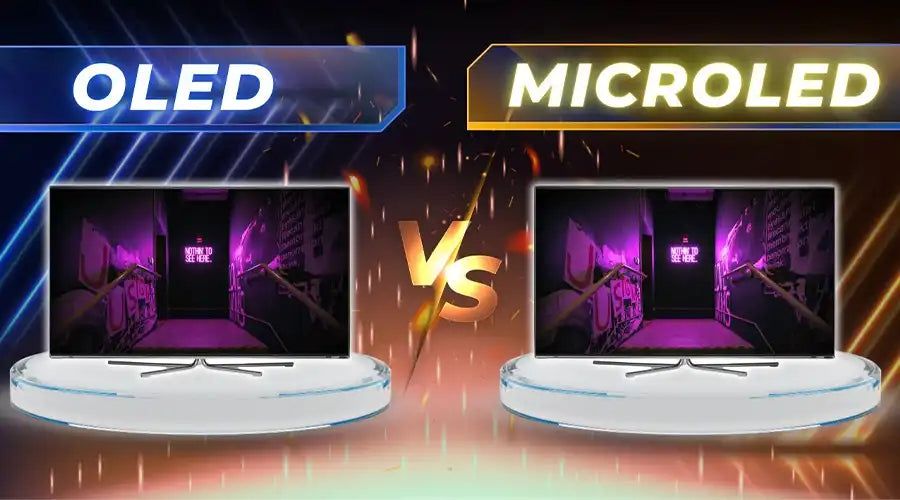
Display Technology Comparison
An engineer-focused comparison of emissive display technologies for brightness, color, reliability, manufacturing, and application fit
OLED and MicroLED are two high-performance emissive display technologies that frequently appear in product roadmaps for smartphones, televisions, automotive displays, professional monitors, and AR or VR devices. While both technologies create light at the pixel level and deliver true black performance, their material systems, manufacturing methods, and practical deployment profiles are very different.
This article provides a structured comparison of OLED vs MicroLED across device physics, brightness and HDR behavior, color performance, lifetime and burn-in, manufacturing difficulty, scalability, optical integration, and application selection.
Definitions: What are OLED and MicroLED?
OLED
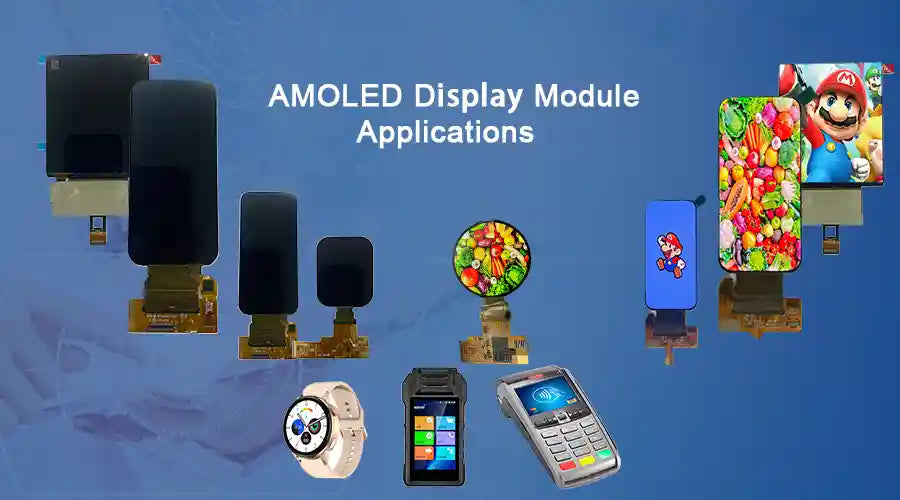
OLED, or Organic Light-Emitting Diode, is an emissive display technology in which organic semiconductor layers generate light when current passes through them. In practical products, OLED is most commonly deployed in AMOLED architectures for high-resolution and video-capable displays. OLED panels can be very thin, can support flexible substrates in some implementations, and are known for excellent contrast because black pixels emit no light.
MicroLED
MicroLED is an emissive technology that uses microscopic inorganic LED chips as individual sub-pixels. These micro-scale emitters are commonly based on inorganic semiconductor materials and can provide very high brightness, strong efficiency at elevated luminance, and long operational life. MicroLED is especially attractive for applications requiring extreme brightness, strong durability, or high pixel density in advanced optical systems.

Device Physics and Pixel Architecture
OLED Stack and Emission Mechanism
An OLED sub-pixel typically includes an anode, transport layers, one or more emissive organic layers, and a cathode. Light is produced when electrons and holes recombine within the emissive region. Different emitter systems, including fluorescent, phosphorescent, and related advanced material families, are used depending on efficiency, color, and lifetime targets.
MicroLED Die and Inorganic Emission
MicroLED sub-pixels are composed of microscopic inorganic LED dies. These devices rely on carrier recombination inside semiconductor junctions, similar to conventional LEDs, but scaled down dramatically and assembled into display arrays. Their inorganic nature contributes to their strong lifetime and brightness characteristics.
Pixel Addressing and Backplane Strategy
AMOLED typically uses an active-matrix TFT backplane such as LTPS, LTPO, or oxide-based approaches to control current at the pixel level. MicroLED can be paired with several drive architectures, including CMOS backplanes, hybrid active matrices, and other integration approaches depending on display size, pitch, and target application.
Manufacturing Methods and Yield Factors
OLED Manufacturing Process
OLED production generally combines a prepared TFT backplane with deposition of organic layers, followed by encapsulation to protect the panel from oxygen and moisture. Yield can be influenced by particle contamination, mask accuracy, layer uniformity, encapsulation quality, and thermal process control.
MicroLED Manufacturing and Mass Transfer Challenge
The core difficulty for MicroLED manufacturing is transferring extremely large numbers of microscopic LED dies onto the target substrate with high speed, high alignment accuracy, and acceptable defect rates. This challenge becomes especially severe for high-resolution small displays, where transfer throughput, repair strategy, and per-pixel quality control all become major cost drivers.
Performance Comparison
Brightness and HDR
MicroLED is widely recognized for superior peak brightness potential because inorganic emitters can tolerate higher drive conditions and maintain strong output. This makes MicroLED highly attractive for bright-environment viewing, outdoor systems, and display categories that demand sustained high luminance. OLED can also provide excellent HDR experiences, especially in premium mobile devices and televisions, but large-area brightness is often constrained by thermal management and long-term material stress.
Color Gamut, Accuracy, and Uniformity
MicroLED can provide very strong spectral purity depending on the color generation method used. OLED also delivers wide-gamut color performance and can achieve highly refined visual quality in commercial products through calibration, panel compensation, and optical optimization. In real products, both technologies can produce premium image quality, but implementation quality matters greatly.
Response Time and Motion
Both OLED and MicroLED offer very fast pixel response compared with LCD technologies. This enables strong motion clarity, low blur, and suitability for gaming, fast interface rendering, and near-eye display systems. MicroLED also benefits from the inherently fast switching behavior of inorganic LEDs.
Power Consumption Models
Power consumption in both OLED and MicroLED depends strongly on image content and luminance. OLED can be very efficient with dark user interfaces and low average picture level content because black pixels consume very little or no light-generation power. MicroLED can be highly efficient at high brightness operation and may be especially attractive where sustained luminance is a core requirement.

Reliability, Burn-In, and Lifetime
OLED Aging and Burn-In
OLED materials degrade over time as they accumulate electrical and thermal stress. Blue emitters have historically posed the greatest lifetime challenge, and static high-contrast content can increase visible differential aging. Manufacturers address this with material improvements, compensation algorithms, sub-pixel design choices, and usage mitigation features.
MicroLED Longevity
MicroLED relies on inorganic emitters, which generally provide stronger long-term operational stability than organic systems. For this reason, MicroLED is often considered a better fit for applications requiring long service life, high brightness, and reduced susceptibility to burn-in-like behavior.
Environmental Robustness and Protection
OLED depends on highly effective encapsulation because organic materials are sensitive to moisture and oxygen. MicroLED is more inherently robust at the emitter level, though packaging quality, bonding integrity, and optical protection layers remain important for long-term field performance.
Scalability and Cost
OLED: Mature Scale and Competitive Cost
OLED benefits from an established manufacturing ecosystem in smartphones, wearables, and premium television categories. This maturity helps reduce cost in mainstream product classes and supports broad commercial availability.
MicroLED: High Potential with Current Cost Premium
MicroLED remains more expensive in many cases because of transfer complexity, die inspection, repair strategy, and integration overhead. However, it becomes highly compelling in categories where brightness, lifetime, or modularity create enough value to justify the manufacturing burden.
System Integration and Optical Stack

Optical Coatings and Reflectance Control
Both OLED and MicroLED benefit from anti-reflective coatings, bonding strategies, and optical stack engineering that reduce glare and improve visible contrast. In very fine-pitch MicroLED systems, additional optical structures may be used to improve fill factor perception and viewing smoothness.
Touch and Sensor Integration
Touch integration is highly mature in AMOLED ecosystems. MicroLED implementations may require additional co-design around drivers, sensor layers, interconnect density, and optical efficiency depending on the product architecture.
Application Comparison and Recommended Choices
Smartphones and Tablets
OLED is currently the mainstream premium solution for smartphones and many tablets because it balances cost, color performance, contrast, thinness, and mature supply chain readiness. MicroLED for mobile devices remains promising but is still limited by manufacturing economics.
Large TVs and Home Theater
OLED provides exceptional cinematic black performance and premium image quality in home entertainment. MicroLED is especially attractive at the very high end, particularly when extreme brightness, modular scaling, or luxury large-format installation is required.
Outdoor Signage and Professional Displays
MicroLED is strongly positioned for outdoor or very high-brightness professional applications because it can sustain higher luminance and deliver long service life in demanding environments.
AR and VR Microdisplays
MicroLED is a major candidate for future AR and advanced near-eye optical systems because of its high brightness and strong potential for very dense pixel structures. OLED microdisplays are also important, especially where ecosystem maturity and existing availability are advantageous.
Automotive and Cockpit Systems
Automotive display selection depends on luminance, temperature tolerance, long-term reliability, and optical readability. In high-demand use cases such as advanced cockpit displays and HUD-related systems, MicroLED can be particularly appealing, while automotive-grade OLED remains relevant where premium image quality and design flexibility matter.

Quick Side-by-Side Comparison
| Category | OLED or AMOLED | MicroLED |
|---|---|---|
| Peak brightness | Strong, especially in premium HDR products, but more limited at full-screen load | Very high, with strong suitability for bright environments |
| Contrast and black level | Excellent | Excellent |
| Lifetime and burn-in resistance | Good but affected by organic aging and static-use patterns | Excellent due to inorganic emitter stability |
| Color purity | High | Very high potential |
| Manufacturing maturity | Mature in many consumer formats | Less mature and more manufacturing-intensive |
| Cost | More competitive in mainstream categories | Higher in many current implementations |
| Best use cases | Phones, TVs, wearables, flexible display products | High-brightness signage, advanced microdisplays, premium modular systems |
FAQ
Is MicroLED better than OLED in every way?
No. MicroLED has major advantages in brightness and longevity, but OLED remains more mature and cost-effective in many mainstream consumer applications.
Will MicroLED replace OLED?
MicroLED is likely to grow strongly in specific premium and specialty segments, but OLED will remain highly relevant in many device categories where manufacturing maturity and cost matter.
Which is better for AR and VR?
MicroLED is highly promising for AR and advanced near-eye systems because of its brightness and dense pixel potential, while OLED microdisplays continue to play an important role depending on product priorities.
Are there hybrid technologies to consider?
Yes. QD-OLED, Mini-LED backlit LCD systems, and color-conversion approaches all remain important parts of the broader display technology landscape.
What should product teams prioritize when choosing?
Define required brightness, lifetime, pixel density, thermal envelope, integration constraints, and cost target before selecting the display architecture.
Conclusion and Selection Checklist
In practical product development, choose OLED when you need a proven, cost-effective, high-contrast display solution for smartphones, televisions, wearables, and many premium consumer products. Choose MicroLED when your system demands extreme brightness, very long service life, premium modularity, or advanced near-eye performance.
The most effective selection framework is based on a concise engineering target set: peak luminance, average picture level, lifetime target, pixel density, thermal constraints, integration complexity, and cost per unit.
Share target size, pixel density, operating hours per day, environmental range, and brightness requirement to build a practical OLED vs MicroLED decision path.

Hinterlasse einen Kommentar
Diese Website ist durch hCaptcha geschützt und es gelten die allgemeinen Geschäftsbedingungen und Datenschutzbestimmungen von hCaptcha.